
Click on the yellow banner above to sign.
Sign-On Opportunity for Stakeholders in Kentucky: Support KBML Process to Align Regulation of Buprenorphine Prescribing With Evidence:
Dr. James Patrick Murphy is spearheading an opportunity for stakeholders to sign onto a letter to the Kentucky Board of Medical Licensure (KBML) urging it stop finalization of proposed changes to 201 KAR 9:270, a regulation governing the prescribing of buprenorphine for the treatment of opioid use disorder (OUD), and instead form a new workgroup charged with conducting a thorough review of the regulation and recommending revisions through a transparent process.
The KBML’s current proposed changes risk perpetuating severe harm during a rapidly evolving addiction and overdose crisis, are inconsistent with evidence-based practice, create new treatment barriers, and may even worsen the addiction and overdose crisis in Kentucky.
- By signing this form, you are indicating you would like your signature on the letter found at this link.
- Please sign on no later than 11:59 pm, August 22, 2024.
- Please forward this widely to stakeholders in Kentucky and urge them to also sign and pass along.
Please also note you will also be subject to the following disclaimer if you sign the letter:
“The views expressed herein are those of the individual signatories and do not necessarily represent the views of their institutions or organizations.”
Points to ponder…
Problem: Kentucky’s buprenorphine regulation is outdated and presents a barrier to patients accessing this life saving medication.
Ask: The KBML needs to convene a new workgroup of diverse experts and stakeholders and extensively overhaul the current regulation.
Fact: Buprenorphine has been shown to decrease mortality by approximately 50% among persons with opioid-use disorder.
Background: On December 29, 2022, the Mainstreaming Addiction Treatment Act (MAT) was passed by Congress, removing the X-waiver registration requirement for prescribers of buprenorphine. The MAT Act is intended to reduce federal policy barriers for clinicians to prescribe buprenorphine in further hopes of bringing buprenorphine treatment into mainstream medical care to narrow treatment gaps and improve treatment access along the entire care continuum (e.g., hospitals, emergency rooms, skilled nursing facilities, primary care, and criminal-legal facilities that provide health care).
On January 12, 2023, heralding the elimination of the X-Waiver, the DEA sent a letter to all DEA registrants (see DEA letter), that included this declaration:
Medication for opioid use disorder helps those who are fighting to overcome opioid use disorder by sustaining recovery and preventing overdoses. At DEA, our goal is simple: we want medication for opioid use disorder to be readily and safely available to anyone in the country who needs it.
The American Society of Addiction Medicine (ASAM) does not endorse or support state-level buprenorphine regulations that are more restrictive than federal regulations. This is because restrictive buprenorphine regulations are a known potential barrier to patient access to buprenorphine treatment. Kentucky is among a minority of states with buprenorphine regulations. On measure, Kentucky’s buprenorphine regulation is significantly more restrictive than federal regulations and, indeed, creates a barrier to patients accessing care.
Kentucky’s buprenorphine regulation 201 KAR 9:270 (fundamentally unchanged since 2015) is not evidence-based (i.e., inconsistent with SAMHSA, FSMB, ASAM), dissuades clinicians from offering buprenorphine (i.e., fear of regulatory scrutiny, increased cost, encourages harmful stigma and bias, complicated and unclear), and creates an environment unattractive to patients (i.e., stigma, cost, unnecessary requirements, inconvenience, loss of autonomy).
Studies have shown that the lack of buprenorphine treatment access is directly linked to the increased diversion of buprenorphine. And as diverted buprenorphine is very often used for its intended medical purpose by persons who cannot access treatment themselves, lowering barriers that impede access to buprenorphine may, in fact, be the most effective way to reduce diversion of buprenorphine.
Many of Kentucky’s regulatory requirements are: (1) not based on evidence and best practices as established by the addiction medicine field and (2) disregard the fact that every patient’s addiction must be treated in an individualized manner (see Michelle Dr. Lofwall’s op-ed below). Certain mandatory requirements (see list below) create a high barrier to accessing treatment with buprenorphine, while current best practices recommends a low barrier approach (see SAMHSA Advisory on low barrier models of care).
The high barrier approach created by Kentucky’s buprenorphine regulation (see KYSAM letter) puts unnecessary burdens on providers and patients, forcing both groups to engage in certain aspects of treatment that may not be necessary based on the patient’s individual needs. This causes: (a) some providers to not prescribe buprenorphine and (b) some patients to not have access to this life-saving treatment
Specific areas where Kentucky’s buprenorphine regulation is outdated and fosters unnecessary barriers to care include:
- Required visits and frequency of visits (i.e., should be determined by an individual clinician based upon clinical judgment and the individual needs of the patient).
- Requirements for in-office initiation vs. home initiation of treatment with buprenorphine.
- Non-evidence-based limitations and restrictions on buprenorphine monoproduct vs. buprenorphine/naloxone combination.
- Prescriber qualifications to prescribe buprenorphine products to treat OUD (i.e., educational requirements, X-waiver).
- The appropriateness of co-prescribing buprenorphine with other medications such as benzodiazepines and gabapentin.
- Appropriate treatment of pregnant patients, e.g., requirement for an independent consultation prior to initiating treatment.
- Quantity limits on buprenorphine (i.e., dose limits).
- Requirements for counseling or other behavioral modification services.
- Mandatory urine drug testing (e.g., frequency, number and specific drugs tested).
- Mandatory lab testing (e.g., pregnancy, HIV, Hep C, etc.)
- Restrictions on off-label use of buprenorphine for pain management.
- Guarantees against drug interactions.
- Mandatory use of subjective clinical tools (e.g., a COWS scale).
- Requiring patients to report the lost or stolen medications to police or other law enforcement agencies, which is punitive and unnecessary, as this could prevent patients from returning to treatment if their medication is lost, stolen, or diverted. Such requirements can put patients’ lives at risk.
Summary: Because each patient is unique, and because scientific knowledge and clinical best practices change over time, Kentucky’s buprenorphine regulation must allow for care that is informed by:
(1) the needs of the individual patient,
(2) the changing body of scientific and clinical knowledge, and
(3) the clinical judgment of the physician.
Kentucky’s current buprenorphine regulation does not achieve this goal.
For the past three years,
Kentucky’s overdose death rate
has remained at or near a record high.
Kentucky’s current buprenorphine regulation is more harmful than helpful.
Change is needed.
Now.
Here is the petition you will be signing…
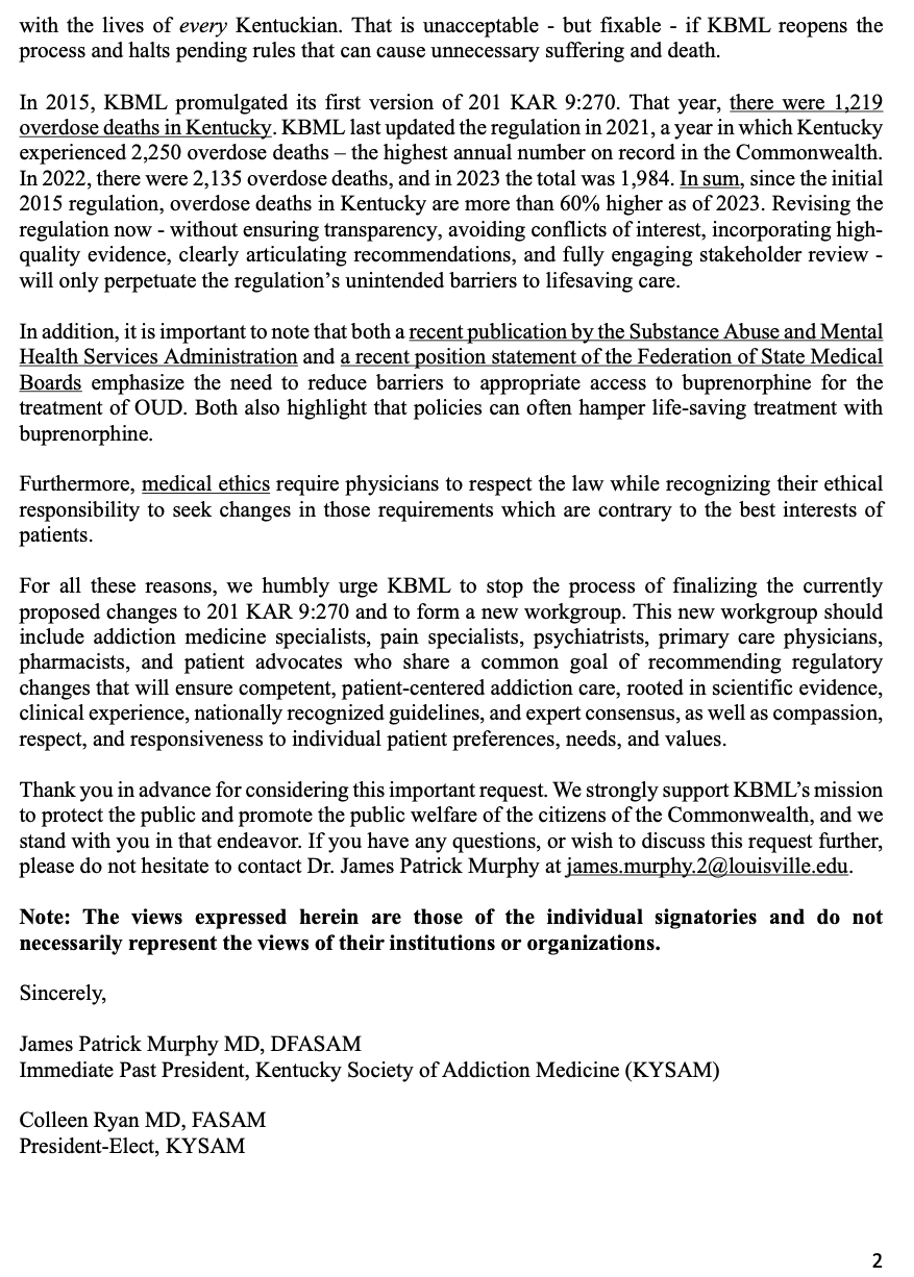
Dear President Thornbury:
As deeply concerned citizens of the Commonwealth of Kentucky, we write to urge the Kentucky Board of Medical Licensure (KBML) to (1) stop its current process of finalizing proposed changes to 201 KAR 9:270, a regulation governing the prescribing of buprenorphine for the treatment of opioid use disorder (OUD), and (2) form a new workgroup – charged with conducting a thorough review of the regulation and recommending revisions through a transparent and open process. While we are incredibly grateful for KBML’s recognition of the urgent need to update 201 KAR 9:270, KBML’s currently proposed changes risk perpetuating severe harm during a rapidly evolving addiction and overdose crisis.
On or about June 4, 2024, KBML informed several stakeholders of an updated draft of 201 KAR 9:270, aimed “to bring the regulation into conformity with current acceptable and prevailing professional standards.” However, the proposed changes will not achieve KBML’s stated goal. They are inconsistent with current evidence-based practice, create new treatment barriers, and may even worsen Kentucky’s addiction and overdose crisis.
Buprenorphine is a highly effective treatment for OUD, which reduces illicit opioid use, reduces pharmaceutical opioid misuse, decreases risk for injection-related infectious diseases, and decreases risk for fatal and nonfatal overdoses. OUD treatment with buprenorphine is also associated with reduced general health care expenditures and utilization, such as fewer inpatient hospital admissions and emergency department visits. Despite buprenorphine’s effectiveness in significantly cutting opioid-related mortality, less than 20% of people with OUD receive medications for their disorder, partly due to regulatory barriers like those in Kentucky’s 201 KAR 9:270.
In fact, if KBML does not reopen its rule process and address 201 KAR 9:270’s requirements that interfere with a physician’s ability to exercise proper clinical judgment, then the consequences for the Commonwealth will be severe. Continuing to restrict appropriate access to treatment for OUD with buprenorphine increases the risk of non-fatal and fatal overdoses, overall health care costs, and fear among physicians and patients alike. We only further strain Kentucky’s safety net hospitals and emergency departments whenever rules dissuade physicians from appropriately treating OUD with buprenorphine. Indeed, failure to reopen KBML’s rule process means gambling with the lives of every Kentuckian. That is unacceptable – but fixable – if KBML reopens the process and halts pending rules that can cause unnecessary suffering and death.
In 2015, KBML promulgated its first version of 201 KAR 9:270. That year, there were 1,219 overdose deaths in Kentucky. KBML last updated the regulation in 2021, a year in which Kentucky experienced 2,250 overdose deaths – the highest annual number on record in the Commonwealth. In 2022, there were 2,135 overdose deaths, and in 2023 the total was 1,984. In sum, since the initial 2015 regulation, overdose deaths in Kentucky are more than 60% higher as of 2023. Revising the regulation now – without ensuring transparency, avoiding conflicts of interest, incorporating high- quality evidence, clearly articulating recommendations, and fully engaging stakeholder review – will only perpetuate the regulation’s unintended barriers to lifesaving care.
In addition, it is important to note that both a recent publication by the Substance Abuse and Mental Health Services Administration and a recent position statement of the Federation of State Medical Boards emphasize the need to reduce barriers to appropriate access to buprenorphine for the treatment of OUD. Both also highlight that policies can often hamper life-saving treatment with buprenorphine.
Furthermore, medical ethics require physicians to respect the law while recognizing their ethical responsibility to seek changes in those requirements which are contrary to the best interests of patients.
For all these reasons, we humbly urge KBML to stop the process of finalizing the currently proposed changes to 201 KAR 9:270 and to form a new workgroup. This new workgroup should include addiction medicine specialists, pain specialists, psychiatrists, primary care physicians, pharmacists, and patient advocates who share a common goal of recommending regulatory changes that will ensure competent, patient-centered addiction care, rooted in scientific evidence, clinical experience, nationally recognized guidelines, and expert consensus, as well as compassion, respect, and responsiveness to individual patient preferences, needs, and values.
Thank you in advance for considering this important request. We strongly support KBML’s mission to protect the public and promote the public welfare of the citizens of the Commonwealth, and we stand with you in that endeavor. If you have any questions, or wish to discuss this request further, please do not hesitate to contact Dr. James Patrick Murphy at james.murphy.2@louisville.edu.
Note: The views expressed herein are those of the individual signatories and do not necessarily represent the views of their institutions or organizations.
Sincerely,
Note: On 8/1/2024, the petition was hand-delivered to the KBML with 450 signatories. We have over 550 signatories now, and the list is growing. You can still sign on and join health care advocates like:
Brian Hurley, M.D.
President, American Society of Addiction Medicine
Stephen M. Taylor, MD
President-Elect, American Society of Addiction Medicine
Kelly J. Clark, MD, MBA, DLFAPA, DFASAM
Past President, American Society of Addiction Medicine and Past President of KYSAM
Colleen Ryan MD, FASAM President-Elect, KYSAM
James Patrick Murphy MD, DFASAM
Immediate Past President, Kentucky Society of Addiction Medicine (KYSAM)
And here’s the resolution that the Greater Louisville Medical Society will be preventing to the Kentucky Medical Association at KMA’s annual meeting August 23, 2024:
RESOLUTION
https://kyma.org/wp-content/uploads/2024/07/2024-12-Review-of-Buprenorphine-Regulation-GLMS.pdf
WHEREAS, according to the 2023 Kentucky Drug Overdose Fatality Report, 1,984 Kentuckians lost their lives last year to a drug overdose, which is more than a 50% increase from 2019; and WHEREAS, recent CDC data lists Kentucky as having the seventh highest overdose death rate in the country; and WHEREAS, recent CDC data indicates approximately 70% of overdose deaths are caused by opioids; and WHEREAS, buprenorphine treatment has been associated with more than a 60% reduction in the risk of opioid-involved overdose death; and WHEREAS, new research out of Kentucky, recently published in the Journal of Addiction Medicine, suggests that higher doses of buprenorphine are associated with reduced opioid-involved overdose deaths and death from other causes; and WHEREAS, 201 KAR 9:270 is a recognized barrier to patients accessing treatment with buprenorphine; and WHEREAS, American Society of Addiction Medicine (ASAM) policy states it is vital that unnecessary and over-burdensome barriers to buprenorphine treatment be avoided so patients can have timely access to care; and WHEREAS, ASAM policy further recommends any state regulation regarding buprenorphine be evidence-based so as not to dissuade clinicians from offering buprenorphine treatment, nor create environments unattractive to patients because of unnecessary and unhelpful regulatory burdens; and WHEREAS, 201 KAR 9:270 is seriously outdated and long overdue for a review and update; and WHEREAS, on or about June 4, 2024, KBML informed stakeholders of an updated draft of proposed changes to 201 KAR 9:270; and WHEREAS, the Kentucky Society of Addiction Medicine and other field experts, have reviewed the KBML’s proposed changes to 201 KAR 9:270 and have concluded that the proposed changes will create environmentsunattractive to patients because of unnecessary and unhelpful regulatory burdens and will not bring the regulation in accord with evidence-based practice but will instead create new treatment barriers and may even worsen Kentucky’s overdose crisis; now therefore be it RESOLVED, that KMA call upon the Kentucky Board of Medical Licensure (KBML) to stop KBML’s process of finalizing proposed changes to 201 KAR 9:270 and promptly convene a diverse workgroup, comprised of experts in the field, tasked with recommending regulatory changes that will ensure competent, evidence-based, and patient-centered treatment of opioid use disorder with buprenorphine.
Addendum and important some links of interest:
Kentucky’s buprenorphine regulation
KYSAM letter to KBML asking for revisions to the buprenorphine regulation
Science-Based Addiction Treatment Must Drive U.S. Policy
Dr. Michelle Lofwall
June 17, 2024
When you’re sick, you go to the doctor.
When you have a life-threatening disease, you get medical treatments to save your life.
When you have opioid use disorder (OUD), you can hit a brick wall, because America’s healthcare systems cannot always deliver the care you need. This is true for several reasons, including stigma, a lack of understanding that addiction is a treatable, chronic medical disease, and an array of restrictive policies and practices, including federal legal barriers that prohibit your state from providing access to one (i.e., methadone) of three OUD medications through prescriptions dispensed from your nearby pharmacy.
In the era of high-potency synthetic opioids, like fentanyl, expanding access to life-saving medications for OUD, particularly methadone and buprenorphine, is critical. Both medications are associated with reduced mortality in people with OUD. They help doctors treat addiction and save lives at a time when opioid-involved overdose deaths are near historic highs. While the latest statistics show the first nationwide drop in overdose deaths in 5 years and an even bigger drop in Kentucky, many states are actually recording significant increases, and Black and Indigenous Americans are still disproportionately more likely to die from an opioid overdose. Illicitly manufactured synthetic opioids can be much more powerful—and deadlier—than heroin and are flooding our communities. Since opioid withdrawal isso excruciating, people with untreated OUD often seek out illicit opioids to prevent pain –– both physical and emotional –– even when they want to stop using them. In contrast, methadone and buprenorphine are proven to help people with OUD manage their disease and be part of the recovery process. New research out of Kentucky, recently published in the Journal of Addiction Medicine, suggests that higher doses of buprenorphine are associated with reduced opioid-involved overdose deaths and death from other causes. Relatedly, methadone may be needed for patients who don’t respond well to buprenorphine. Yet, physicians, even those who are experts in treating addiction, are not always trusted to make appropriate clinical decisions when it comes to these medications.
Unfortunately, despite the recent elimination of a registration requirement for prescribing buprenorphine for OUD, buprenorphine continues to be hindered by burdensome policies, such as non-evidence-based state regulations and unnecessary prior authorization requirements by insurers, even on injectable formulations that cannot be diverted by patients. All these hurdles impede timely access to buprenorphine for OUD and fuel our overdose crisis. Similarly, methadone’s potential is limited by a 50-year-old federal law that is preventing regulators from even trying to increase access to it through prescriptions dispensed from community pharmacies – an approach that has been used successfully in other countries for decades. Consequently, patients who need methadone for OUD must visit one of approximately 2,100 opioid treatment programs (OTPs) in the United States to get their medicine, and for those who can access an OTP, it can still be difficult for some to stay in methadone treatment and maintain their recovery. While OTPs play an important role in the addiction treatment continuum, it’s past time for Congress to pass federal legislation that would empower federal and state regulators to determine how best to access methadone prescribed by addiction specialist physicians for OUD through local pharmacies, which overwhelmingly outnumber OTPs.
Tragically, concerns around methadone and buprenorphine diversion tend to slow necessary reforms. While diversion concerns must be considered and appropriately addressed, they should represent only one aspect of our national conversation when it comes to life-saving medications for OUD, not dominate it. Outdated laws, regulations, and policies governing both buprenorphine and methadone for OUD are failing to meet the moment—and worse, are exacerbating the deadliest overdose crisis in American history.
Dr. Michelle Lofwall is board-certified in psychiatry and addiction medicine. She is a professor of behavioral science and psychiatry and the Bell Alcohol and Addictions Chair at the University of Kentucky College of Medicine. The views expressed herein are those of Dr. Lofwall and do not necessarily represent the views of the University of Kentucky.
 Confluential Truth