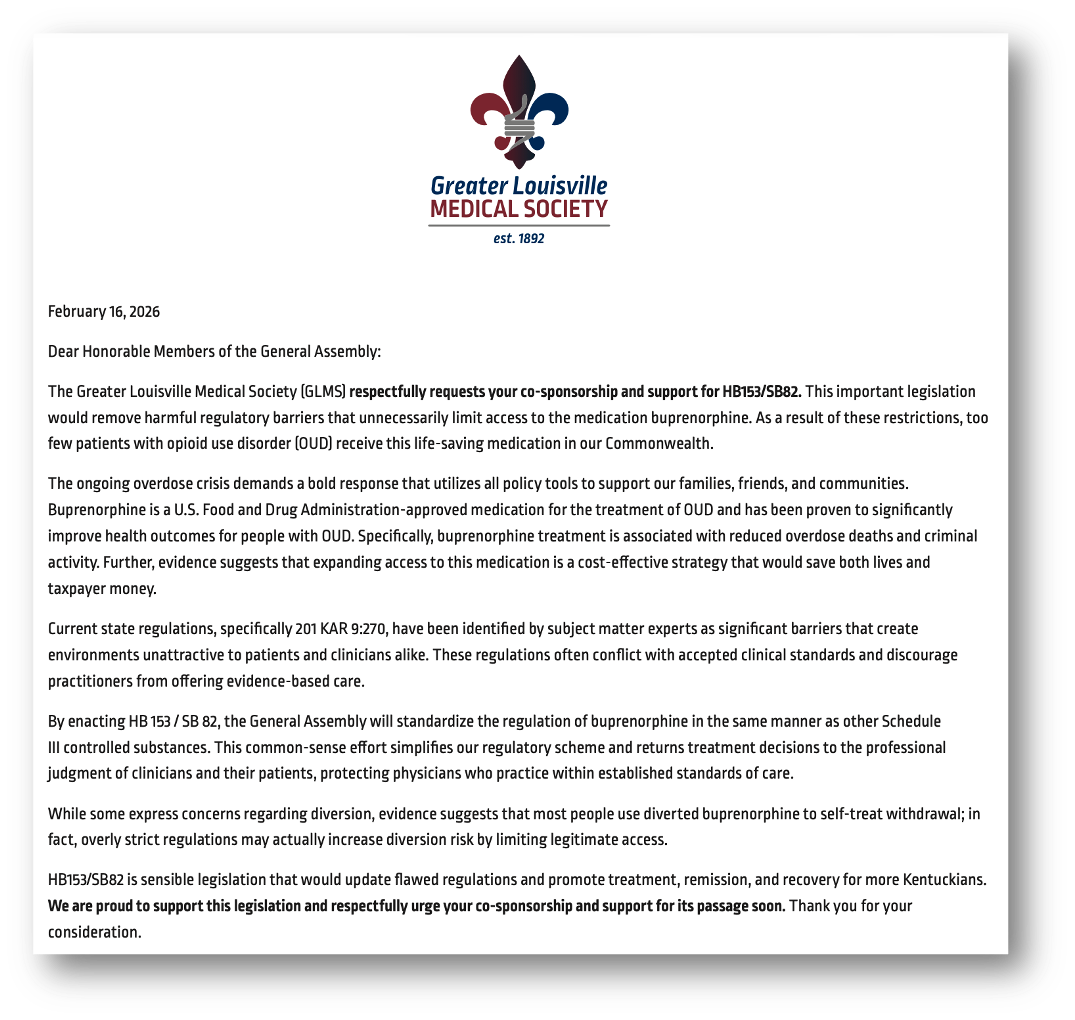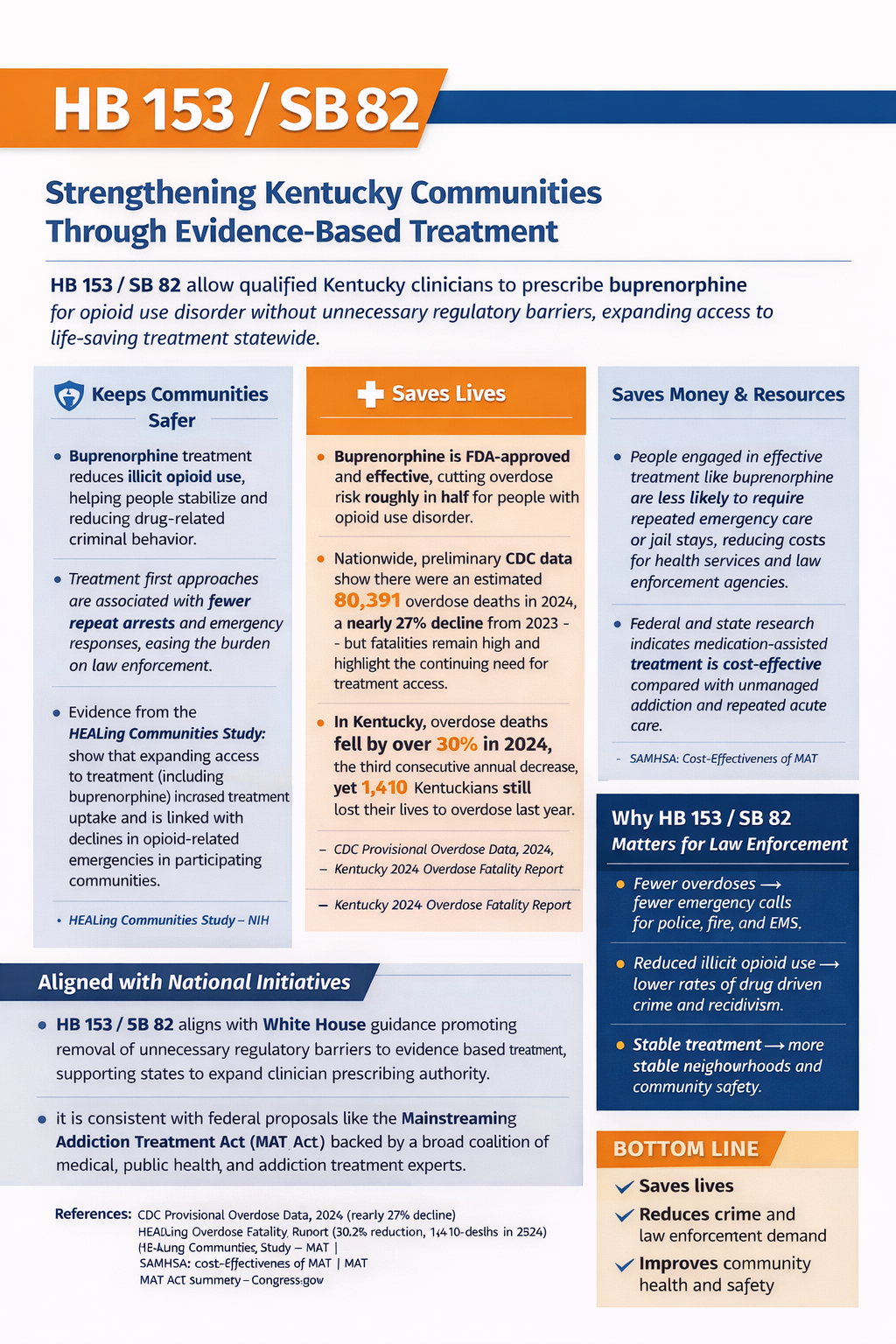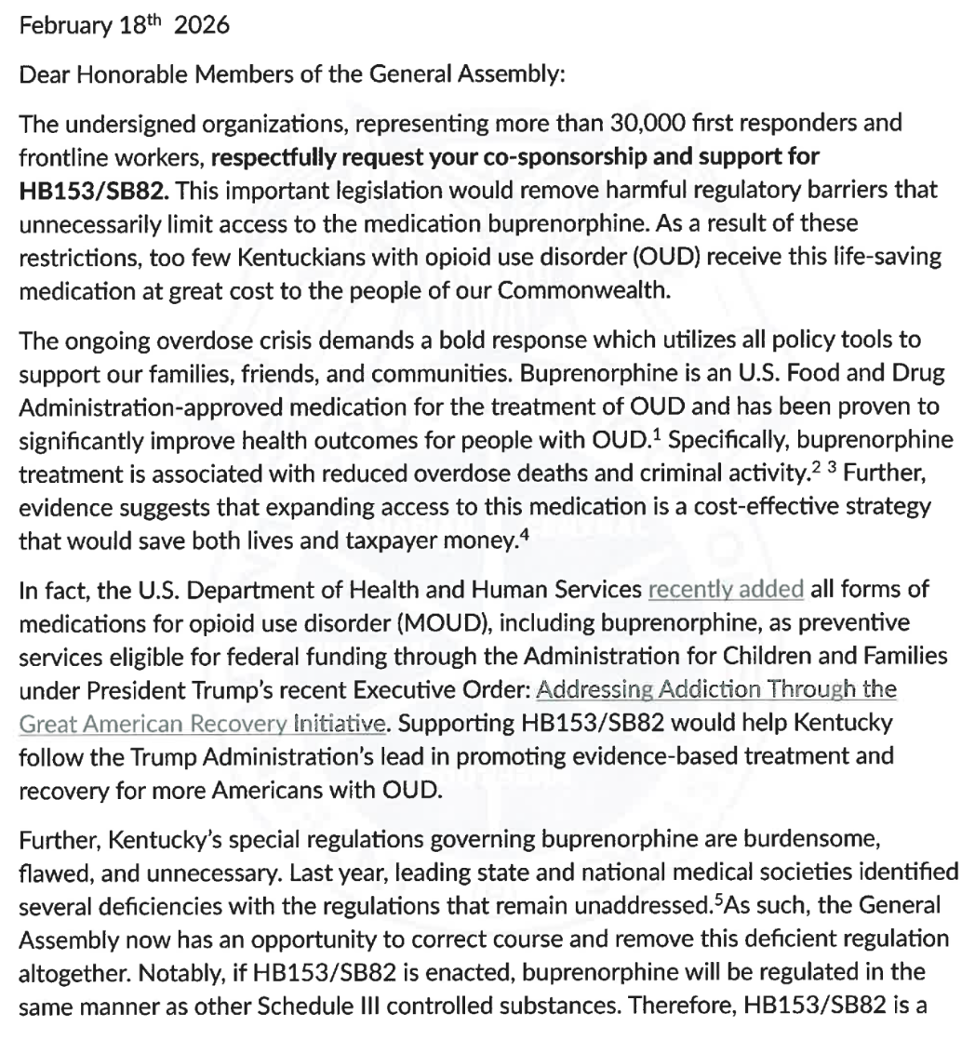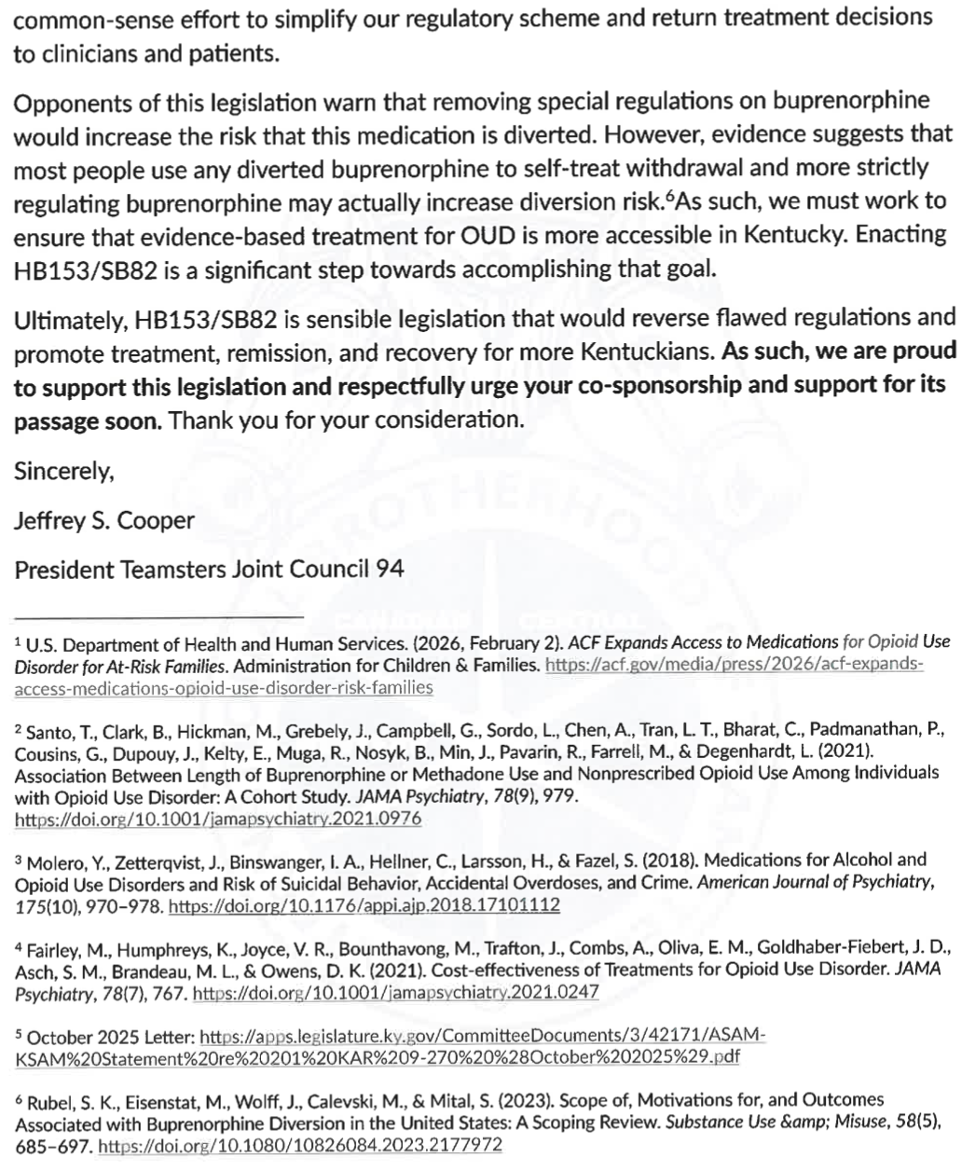
Over 270,000 Kentuckians have opioid use disorder – almost 6% of our state’s population.
While we might be saving more Kentuckians from overdose deaths, we are not seeing fewer overdoses. The number of overdose events in Kentucky is actually rising.
And about four Kentuckians die from overdose every single day.
But light is coming…
Senator Julie Raque Adams, has submitted a bill request to fix this problem. The bill, which is still being finalized: (1) restores autonomy for patients, (2) empowers EMS to treat within the full scope of their practice, (3) protects physicians practicing responsibly, and (4) ensures veterans can access medications endorsed by the experts in accordance with research-based best practices.
In short, this bill will save lives.
Treatment approaches for addiction are generally as successful as those for other chronic diseases, and buprenorphine is proven to be our best medication to treat opioid addiction and prevent overdose deaths. Senator Adams’ bill will allow our loved ones with opioid addiction, who need buprenorphine, to get buprenorphine when they need buprenorphine. Please support Senator Julie Raque Adams’ bill.
The Kentucky General Assembly starts on January 6, 2026.
Questions for our Commonwealth…
• Why is it easier to prescribe OxyContin –which CAUSES addiction—than to prescribe buprenorphine—which TREATS addiction?
• Why are FIRST RESPONDERS allowed to reverse overdoses, but not allowed to prevent overdoses?
• Why are VETERANS denied safe medications – like buprenorphine – only to be forced onto dangerous medications – like fentanyl?
• Why do our state officials proclaim that buprenorphine decreasesoverdoses by50% and then enforce outdated laws that deny access to it?
• And why does our state require a federal “waiver” to prescribe buprenorphine, when the feds eliminated that “waiver” THREE years ago?
Let’s pass Senator Julie Raque Adams’ addiction treatment access bill in 2026 to make these questions moot – and make Kentucky a safer, healthier place to live long and prosper. That would be glorious!
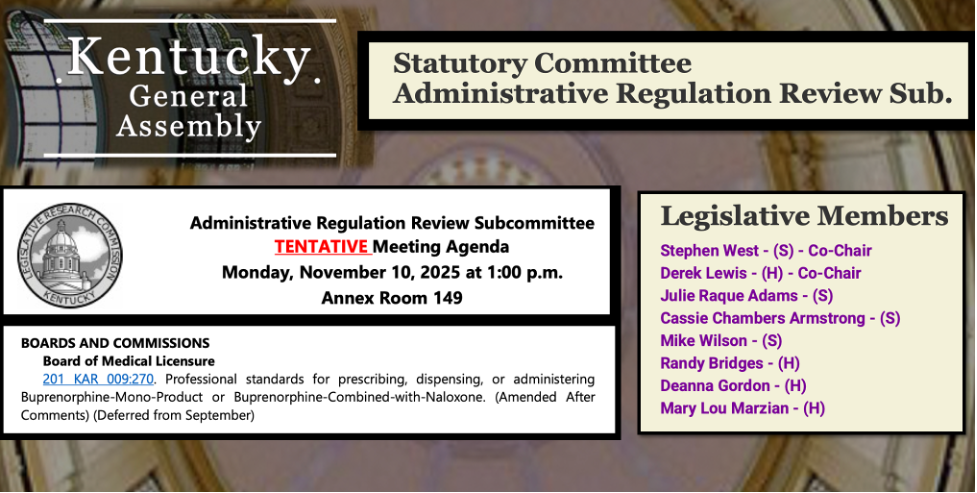
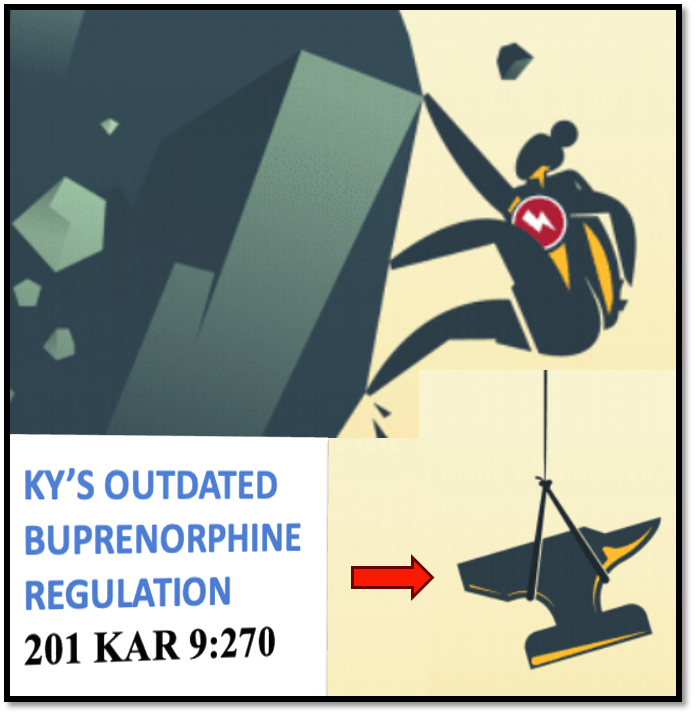
November 10th should have been a turning point in Kentucky’s effort to reduce overdose deaths. But instead of ending a broken and outdated rule, the Administrative Regulation Review Subcommittee (ARRS) stepped in to revive 201 KAR 9:270—Kentucky’s deeply flawed buprenorphine regulation.
It was a moment that called for moral clarity. The appropriate response should have been simple: Do Not Resuscitate.
Yet, the committee chose otherwise.
It was a swing and a miss at a golden opportunity.
What the Voting Members Said
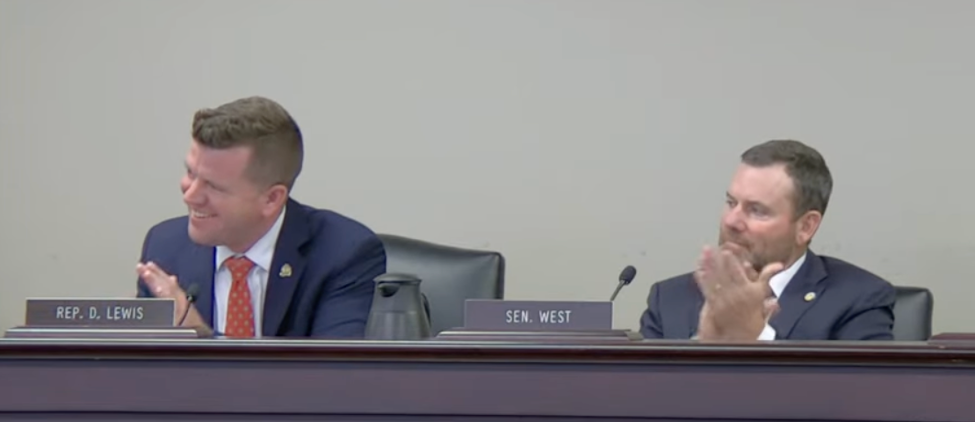
Chairman, Rep. Derek Lewis: “If you’re opposed to finding it [the regulation] deficient and think it should move forward, please vote no.”
Sen. Julie Raque Adams:“Aye.”
Sen. Mike Wilson:“Aye.”
Rep. Randy Bridges:“I’m going to abstain.”
Rep. Deanna Gordon: “I’m going to vote no, but I’m on the health committee, and this is probably the place where it’s going to go after this.”
Rep. Mary Lou Marzian: “I’m going to vote yes, because I’m really disappointed in the lack of communication from the board of medical licensure, and I have found them to be a little bit obstinate in the past.”
Co-Chair, Sen. Stephen West: “I vote no. The main reason… is that the committee of jurisdiction has the subject matter expertise to cover this particular piece of regulation.”
Chairman Lewis: “I am also a no. I do appreciate the testimony. I appreciate the passion. I truly do. We do have a process in place though.”
The Tally
Member
Vote
Meaning
Rep. Marzian
YES
Regulation is deficient
Sen. Adams
YES
Regulation is deficient
Sen. Wilson
YES
Regulation is deficient
Rep. Gordon
NO
Regulation is not deficient
Sen. West
NO
Regulation is not deficient
Rep. Lewis
NO
Regulation is not deficient
Rep. Bridges
ABSTAIN
—
Sen. Armstrong
ABSENT
—
Result: 3 YES, 3 NO.
But because the ARRS seats eightmembers, to find the regulation deficient required a five vote majority.
So the motion to find it deficient failed—and by the slimmest of margins, 201 KAR 9:270 dragged itself out of the gutter and staggered on.
201 KAR 9:270 needed a whopping SIX appearances before ARRS in an eight month span, before it skidded out of committee by the skin of its teeth. If that’s not a red flag, what is?
Shakespeare might have said: “Something is rotten in the state of Denmark.”
My Testimony to the Committee
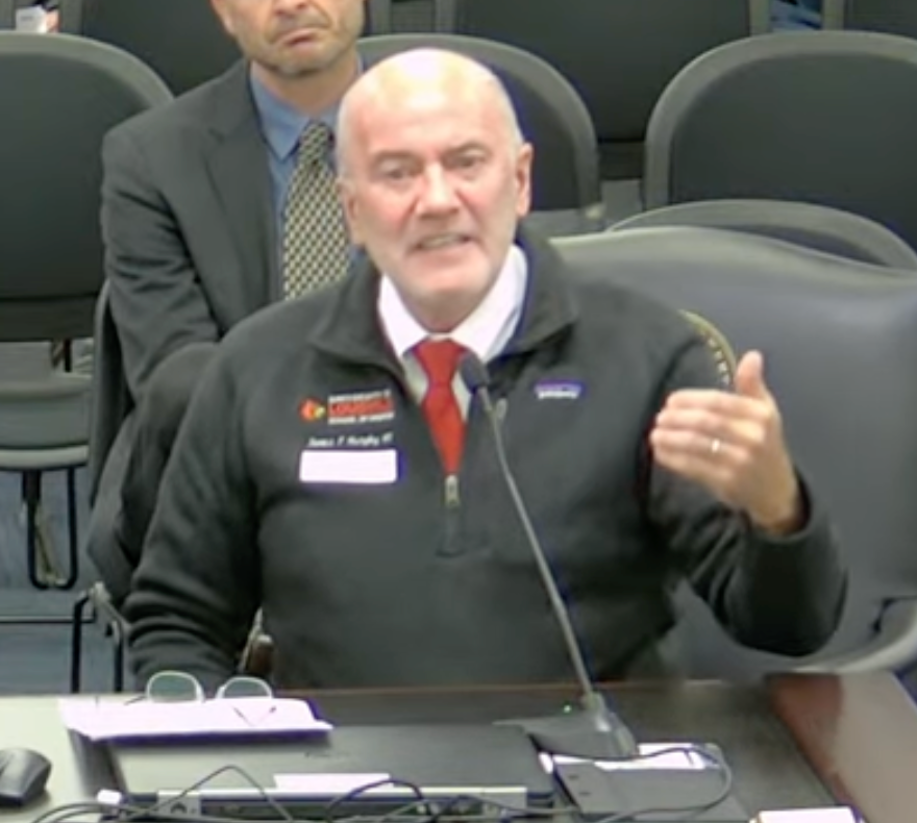
You have enough information. You know what the right answer is. And I ask you on behalf of your families and everyone in this state who is suffering and dying— for the four people who will die today from an overdose. Think about those four people who die every day. Every overdose is preventable.
Don’t let this go forward.
What Happens Next?
Sen. West offered a clue:
“There will be another chance…in the subject matter committee, as well as a legislative session that is coming up. We have 138 members of the General Assembly, and you can ask any of them to file a bill… and they can attack this problem for you.”
He’s right. 201 KAR 9:270 has not cleared all of the hurdles yet. We will have another opportunity, or two, or three…
Kentucky’s 201 KAR 9:270 is a barrier to lifesaving care
If a medication prevents overdose deaths, and a regulation prevents treatment with that medication, then removing that regulation will save lives.
The lifesaving medication is buprenorphine. The barrier regulation is 201 KAR 9:270.
So why is 201 KAR 9:270 still on the books?
On Monday, November 10, 2025, the Administrative Regulation Review Subcommittee (ARRS) of the Kentucky General Assembly will ask that question—again. It’s the same question they asked the Kentucky Board of Medical Licensure (KBML) in October, when they urged the Board to work with the many medical and community groups opposing the regulation and return with a compromise.
A Month Wasted
The record speaks for itself.
October 14, 2025 — ARRS Meeting Discussion KBML President Dr. Thornbury told legislators:
“Mr. Chairman, I think what we’d like to do is work with you and the committee to help our colleagues come together if we can.”
October 16, 2025 Two days later, KBML declined a meeting and asked the Kentucky Society of Addiction Medicine (KYSAM) to submit written amendments instead.
October 24, 2025 KYSAM submitted a detailed 8,000-word, 10-page markup of 201 KAR 9:270, along with an email from KYSAM President Dr. Colleen Ryan extending an open invitation for continued collaboration.
October 31, 2025 No discussion. No dialogue. No compromise. Instead, KBML submitted two inconsequential edits to its 3,000-word regulation:
• Page 3: deleting “a” and inserting “an” • Page 7: replacing “best efforts” with “a good-faith effort.”
Honestly, was this a good-faith effort by the medical board?
Dismissive and Counterproductive
KBML’s response to ARRS is dismissive, perfunctory, and contrary to the spirit of collaboration. For two years, the Board has mechanically engaged with Kentucky stakeholders while refusing to seriously consider the overwhelming professional consensus opposing 201 KAR 9:270. Lives are at stake, yet this pattern of disengagement continues unchecked, raising urgent questions about KBML’s priorities.
A Regulation That Costs Lives
Every day, Kentuckians die from preventable overdoses. Buprenorphine is a proven, evidence-based treatment that dramatically reduces overdose deaths and supports recovery. Yet 201 KAR 9:270 erects unnecessary barriers that make it harder for physicians to prescribe and for patients to receive this lifesaving medication.
When bureaucracy stands between patients and proven treatment, people die.
On October 14, to the ARRS and a televised audience watching on KET (Watch the video at 1:17:28), KBML President Thornbury said the thinking part out loud when he qualified his testimony with:
I want the committee to understand, and
I UNDERSTAND HOW POLITICS IS.
Well, I understand this: with so many Kentuckians dying needlessly every year, reforming this regulation isn’t politics—it’s a moral imperative.
A Call to the ARRS
On November 10, the ARRS will again consider 201 KAR 9:270. I cannot see how anyone in good conscience could support advancing such a deeply flawed regulation.
I respectfully urge the ARRS to return 201 KAR 9:270 to KBML with explicit instructions to engage meaningfully with the medical and addiction-treatment communities—and to seriously consider overhauling or repealing it in favor of a solution that saves, rather than costs, lives.
As ARRS Co-Chair Senator Stephen West said last month:
“My hope is that maybe after the discussions today there would be some possibility of compromise…the reason we’re even asking for this is we realize how very important this decision is…We need to get this right.”
Licensure Board, tear down that regulation — and let Kentucky’s clinicians save lives.
Dr. James Patrick Murphy, MD
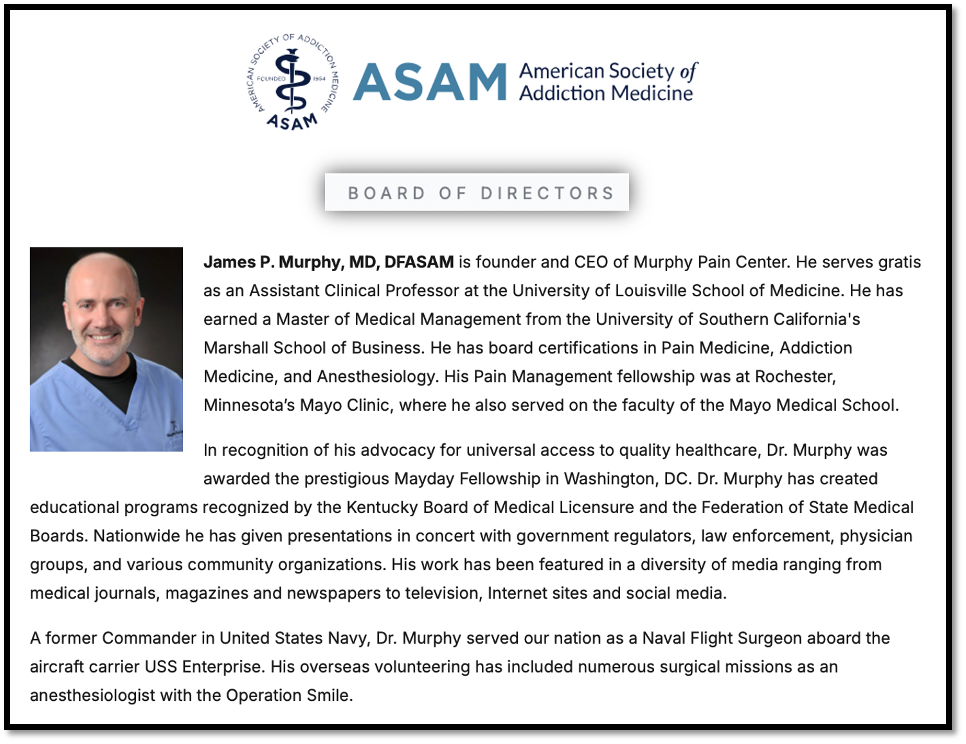
Dr. James Patrick Murphy, Region X Director for the American Society of Addiction Medicine, is a Louisville resident and professor at the University of Louisville School of Medicine.
Please take three minutes to read how you can help a small committee make a BIG impact in the lives of Kentuckians battling opioid addiction.
Buprenorphine — a safe and effective medication for the treatment of opioid use disorder (MOUD) — is vital to reducing overdose deaths. Yet Kentuckians’ access to this lifesaving medication is in jeopardy because of an outdated, ten-year-old regulation still on the books: 201 KAR 9:270.
But there’s hope.
On November 10, 2025, the Administrative Regulation Review Subcommittee (ARRS) of Kentucky’s General Assembly has the power to reject the Kentucky Board of Medical Licensure’s (KBML) flawed update to this harmful rule.
Why the KBML Proposal Must Be Rejected
The KBML’s proposed update to 201 KAR 9:270 is insufficient, critically flawed, and should be sent back for comprehensive revision — or better yet, repealed altogether.
At its heart, this is about access.
Kentuckians battling opioid addiction need fewer barriers to buprenorphine, not more. Yet this regulation does the opposite — it’s full of unnecessary restrictions that are:
Outdated
Unsupported by research
Condemned by experts
Punitive toward people with addiction
Four Truths Everyone Should Know
1. Buprenorphine works.
The Kentucky Opioid Response Effort (KORE) reports that buprenorphine (and methadone) reduce illicit drug use and fatal overdose by over 50% — and improve quality of life.
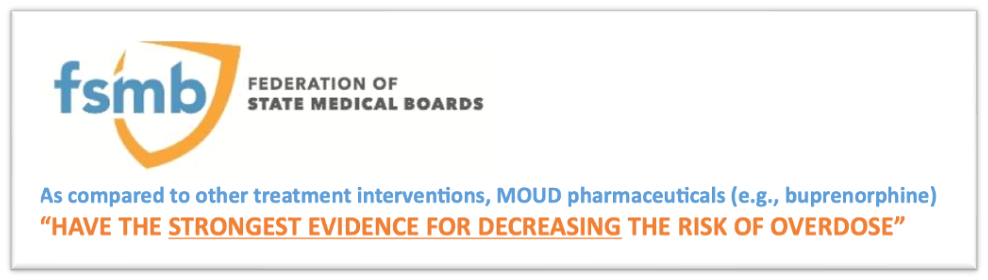
The Federation of State Medical Boards — of which Kentucky is a member — says that “reducing barriers to treatment” with buprenorphine is critical to “decreasing the risk of overdose.”
3. 201 KAR 9:270 is a proven barrier.
A recent study by Kentucky researchers repeatedly cited this KBML regulation as a barrier preventing people from receiving lifesaving treatment.
4. The ARRS has rejected KBML proposals before.
In 2008, after ARRS pushed back, KBML admitted in its fall newsletter:
“Acting on a request of the Kentucky General Assembly’s Administrative Review Subcommittee (ARRS), the Board has agreed to withdraw all of its existing guidelines.”
The Correct Course Is Clear
Reject 201 KAR 9:270.
On November 10, the ARRS can send this regulation back to KBML and direct them to work collaboratively with Kentucky’s addiction medicine specialists and other experts to create evidence-based, compassionate policy that expands access to treatment rather than restricting it.
What You Can Do
You’ve already taken the first step by reading this article. Thank you.
If you want to make your voice heard, contact ARRS members today and urge them to reject KBML’s proposed update to 201 KAR 9:270.
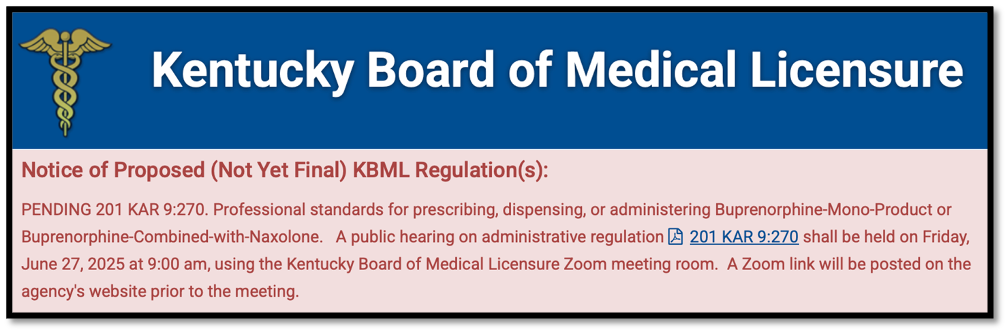
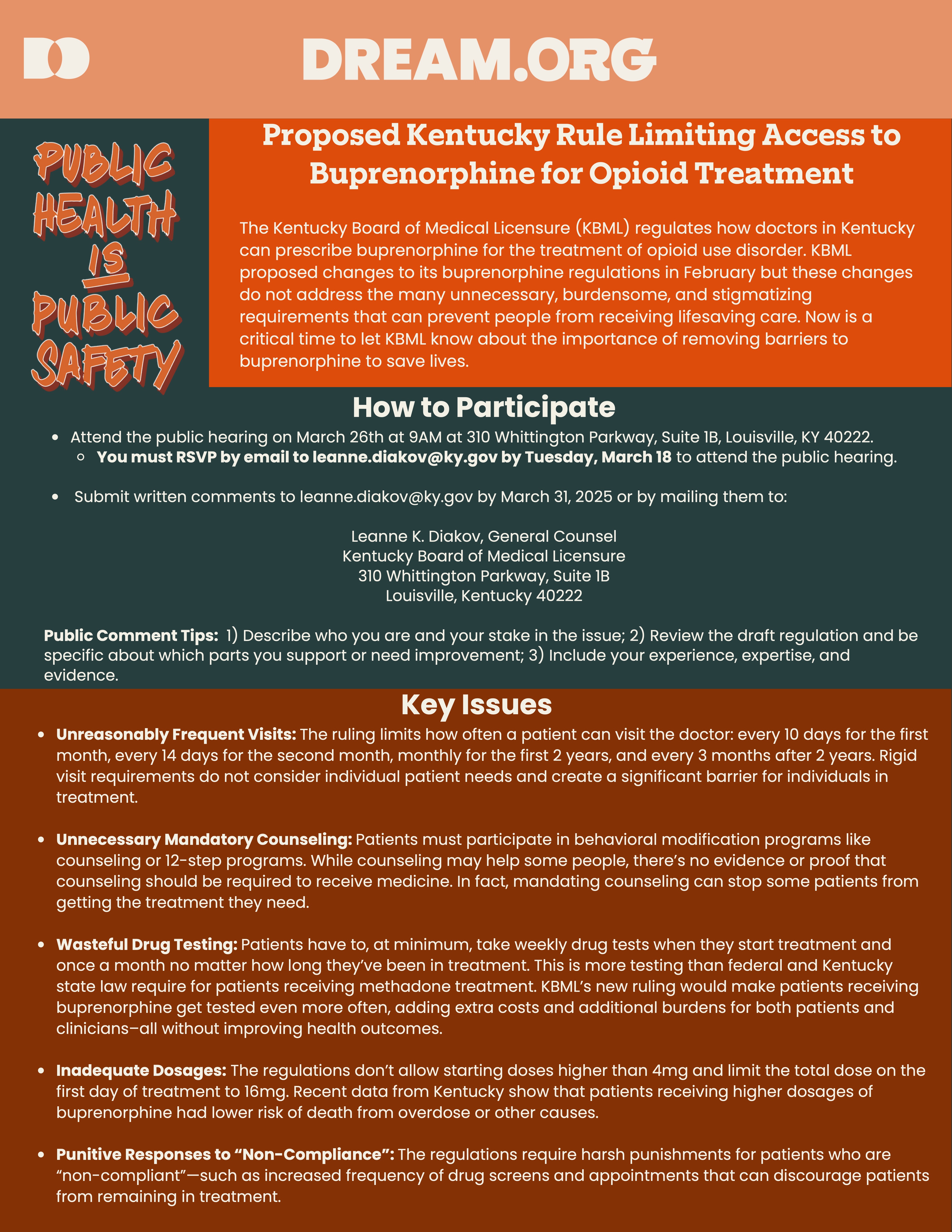
The Kentucky Board of Medical Licensure (KBML) filed their updated version of 201 KAR 9:270 (the buprenorphine regulation) and scheduled an in-person public hearing for March 26, 2025. However, KBML cancelled this hearing due to an overwhelming number of requests by speakers to be heard. KBML has now rescheduled the hearing for June 27, 2025, only this time it’s not in-person. It’s a Zoom meeting! They have not posted the link yet, so stay tuned and monitor the KBML website, link: https://kbml.ky.gov/Pages/index.aspx
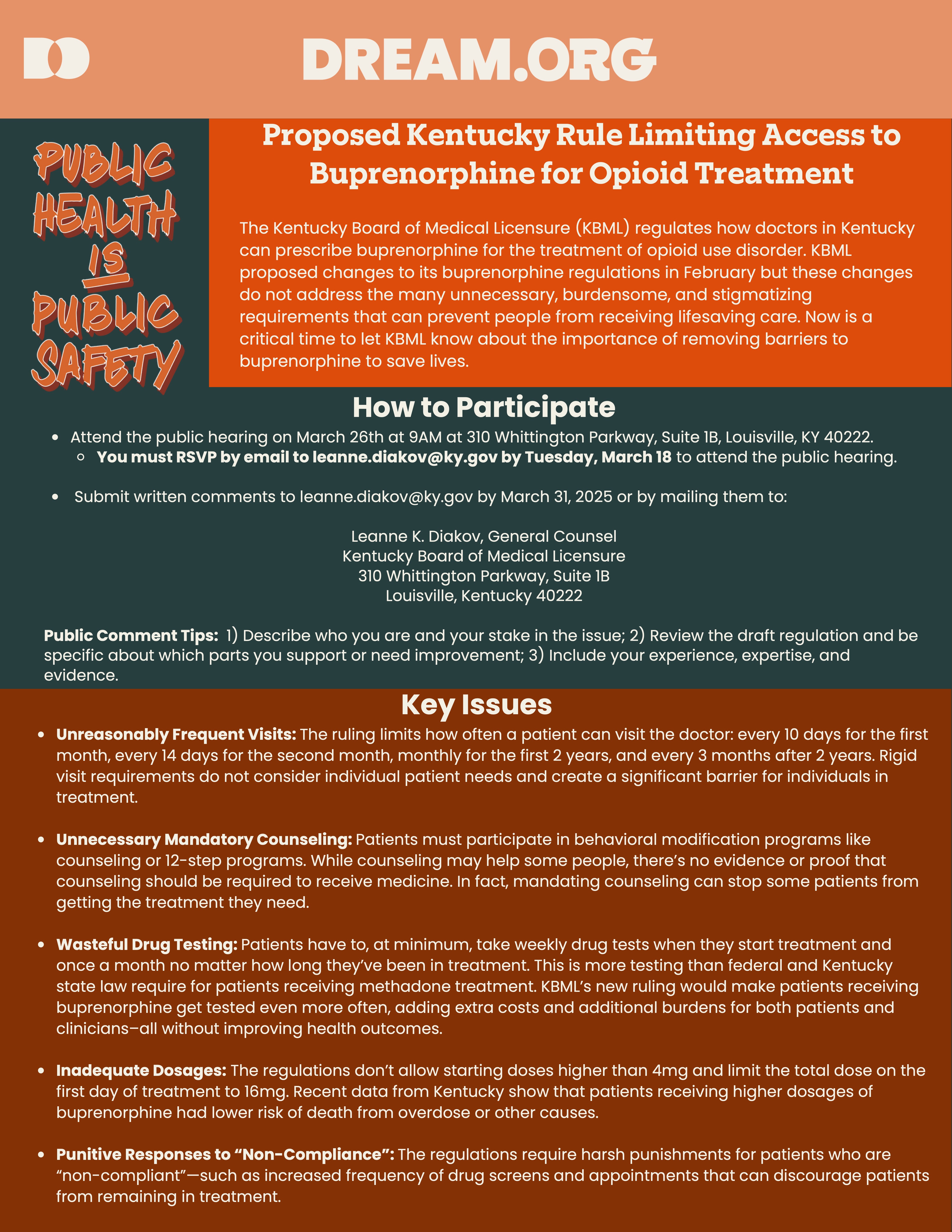
Please mark your calendar for June 27th and spread the news. To review, below is a call to action from Dream.org sent prior to the cancelled March 26th hearing. The same issues are still at stake. Your voice is needed now more than ever! Even if you only Zoom in for thirty seconds. Your participation matters and will help prevent overdose deaths and improve the lives of your neighbors, friends, and loved ones.
HERE’S THE LATEST: The Kentucky Board of Medical Licensure (KBML) filed their updated version of 201 KAR 9:270 (the buprenorphine regulation) and scheduled an in-person public hearing for March 26, 2025. However, KBML cancelled this hearing due to an overwhelming number of requests by speakers to be heard. KBML has now rescheduled the hearing for June 27, 2025, only this time it’s not in-person. It’s a Zoom meeting! They have not posted the link yet, so stay tuned and monitor the KBML website, link: https://kbml.ky.gov/Pages/index.aspx
Please mark your calendar for June 27th and spread the news. To review, below is a call to action from Dream.org sent prior to the cancelled March 26th hearing – NOW JUNE 27. The same issues are still at stake. Your voice is needed now more than ever! Even if you only Zoom in for thirty seconds. YOUR WRITTEN COMMENTS MATTER TOO! THANK YOU!
Dear Friends, Neighbors, and Colleagues,
Now is the time to take action! Your voice can make a difference in Kentucky. A simple email could help save lives. Here’s how: Send an email to the Kentucky Board of Medical Licensure (KBML) via
Leanne K. Diakov, KBML General Counsel at leanne.diakov@ky.gov
To make it easier, simply click on this LINK, where you’ll find a helpful brief to guide you in crafting and sending your email to leanne.diakov@ky.gov
NOTE: KBML HAS RESCHEDULED THE PUBLIC HEARING FOR JUNE 27, 2025, AND ARE ACCEPTING EMIALS AND WRITTEN COMMENTS THROUGH JUNE 27.
Tell KMBL that you do not support the proposed changes Kentucky’s buprenorphine regulation, and you believe Kentucky would be better served by eliminating the entire regulation known as 201 KAR 9:270.
The Kentucky Board of Medical Licensure (KBML) is nearing the final stages of updating the regulation 201 KAR 9:270, which governs the treatment of Opioid Use Disorder with buprenorphine in Kentucky. Even with the proposed changes, this regulation remains flawed and harmful, and KBML has yet to fully acknowledge the impact. You don’t have to take my word for it. Read it for yourself at https://apps.legislature.ky.gov/law/kar/titles/201/009/270/REG/
Unfortunately, KBML’s proposed amendments do not address the damaging, stigmatizing policies first introduced in 2015. But you still have time to help alter this course. Until JUNE 27, you can make your voice heard with an email to KBML.
Despite input from hundreds of specialists, caregivers, and concerned Kentuckians calling for significant revisions to this harmful regulation, KBML has moved forward with publishing insufficient amendments to their outdated regulations on buprenorphine prescribing. Sadly, these amendments do little to improve the situation and further create barriers for patients seeking this life-saving treatment.
Kentucky is out of sync with the rest of the country. While federal guidelines have simplified and streamlined buprenorphine prescribing in recent years, Kentucky remains one of the few states enforcing stricter, punitive measures. Kentucky’s buprenorphine regulation (and its proposed amendments) are not only unsupported by evidence but also contribute to an increase in overdose deaths by limiting access to care.
If 201 KAR 9:270 and its proposed amendments are allowed to proceed, Kentucky will miss the opportunity to align itself with thelatestscientificevidence, expertrecommendations, and current federal guidelines. Continuing with Kentucky’s flawed regulation will only result in more preventable overdose deaths in our state.
A ban on using buprenorphine-naloxone for chronic pain
It’s time to take action!
Now through JUNE 27, you have the opportunity to speak up on behalf of those struggling with opioid use disorder. Email your comments to:
Leanne K. Diakov, KBML General Counsel: leanne.diakov@ky.gov
At the end of this post, you’ll find a sample letter that you can modify to share your personal perspective, if you wish. Personalizing your message can make a big impact!
The Director of the National Institute on Drug Abuse stated that if everyone who needs buprenorphine could access it, overdose deaths could be reduced by half.
201 KAR 9:270 is a barrier preventing Kentuckians from accessing this life-saving medication.
And despite a tsunami of evidence proving the lifesaving effects of this medication, buprenorphine prescribing in Kentucky actually decreased last year! We must do better!
What more motivation do you need? Together, we can make a difference. Let your voice be heard!
Dr. Murphy is Kentucky’s Regional Director for the American Society of Addiction Medicine and is a founding member of the American Medical Association’s Substance Use and Pain Care Task Force. He serves as an Assistant Clinical Professor for the University of Louisville School of Medicine and is board-certified in Anesthesiology, Pain Management, and Addiction Medicine.
***SAMPLE TEXT***
To: Kentucky Board of Medical Licensure Attention: Leanne K. Diakov, General Counsel Email: leanne.diakov@ky.gov
RE: Public Comments on Proposed Amendments to 201 KAR 9:270
Dear Members of the Kentucky Board of Medical Licensure,
I am submitting my public comments on the proposed amendments to 201 KAR 9:270. Rather than addressing Kentucky’s overdose crisis, I am concerned that these proposed changes will only worsen the situation, creating additional barriers to care and limiting access to critical, lifesaving treatments. I respectfully urge the Board to prioritize evidence-based addiction treatment by rejecting these amendments and fully repealing this outdated and harmful regulation.
Expanding access to medications for opioid use disorder, such as buprenorphine, is crucial for reducing overdose deaths. Unfortunately, the proposed amendments directly contradict the guidance from several leading authorities, including the U.S. Department of Health and Human Services, the Drug Enforcement Administration, the Substance Abuse and Mental Health Services Administration, the National Institute on Drug Abuse, and the Federation of State Medical Boards, all of which support broader access to buprenorphine-based treatments. The restrictions outlined in 201 KAR 9:270 would be counterproductive and could exacerbate health disparities, especially within marginalized communities.
If these proposed amendments are enacted, 201 KAR 9:270 will continue to contribute to Kentucky’s tragically high overdose death rate. I fully support the concerns raised by the Kentucky Society of Addiction Medicine, which has reviewed the proposed changes and deemed them insufficient. In light of these concerns, I strongly advocate for the full repeal of 201 KAR 9:270.
Thank you for considering the potential impact of these amendments on the health and well-being of Kentuckians. I urge the Board to prioritize evidence-based addiction treatment by rejecting these amendments and fully repealing this outdated and harmful regulation.
Sincerely, [Your Name] [Your Credentials/Professional Title, if applicable]
Kentucky House Bill 788 (currently in committee) supports increased access to buprenorphine by empowering Kentucky’s providers to treat patients with evidence-based care. Check out this 9 minute video of Dr. Murphy’s recent testimony in Kentucky’s capital city: https://www.youtube.com/watch?v=3lILI0x4TXo
More and more people and organizations are joining this cause…
3/15/2025 UPDATE – For the time being, the ALARM ACT initiative has been merged with HB 788, which was filed by Representative Kim Moser in the Kentucky General Assembly. For more information check out the KYSAM advocacy HB 788 website: https://www.kysam.org/news
Kentucky House Bill 788 supports increased access to buprenorphine by empowering Kentucky’s providers to treat patients with evidence-based care. Check out this 9 minute video of Dr. Murphy’s recent testimony in Kentucky’s capital city: https://www.youtube.com/watch?v=3lILI0x4TXo
The salient issues remain consistent with the ALARM ACT initiative, thus I’m keeping this post on the website to provide historical context supporting our efforts to save lives.
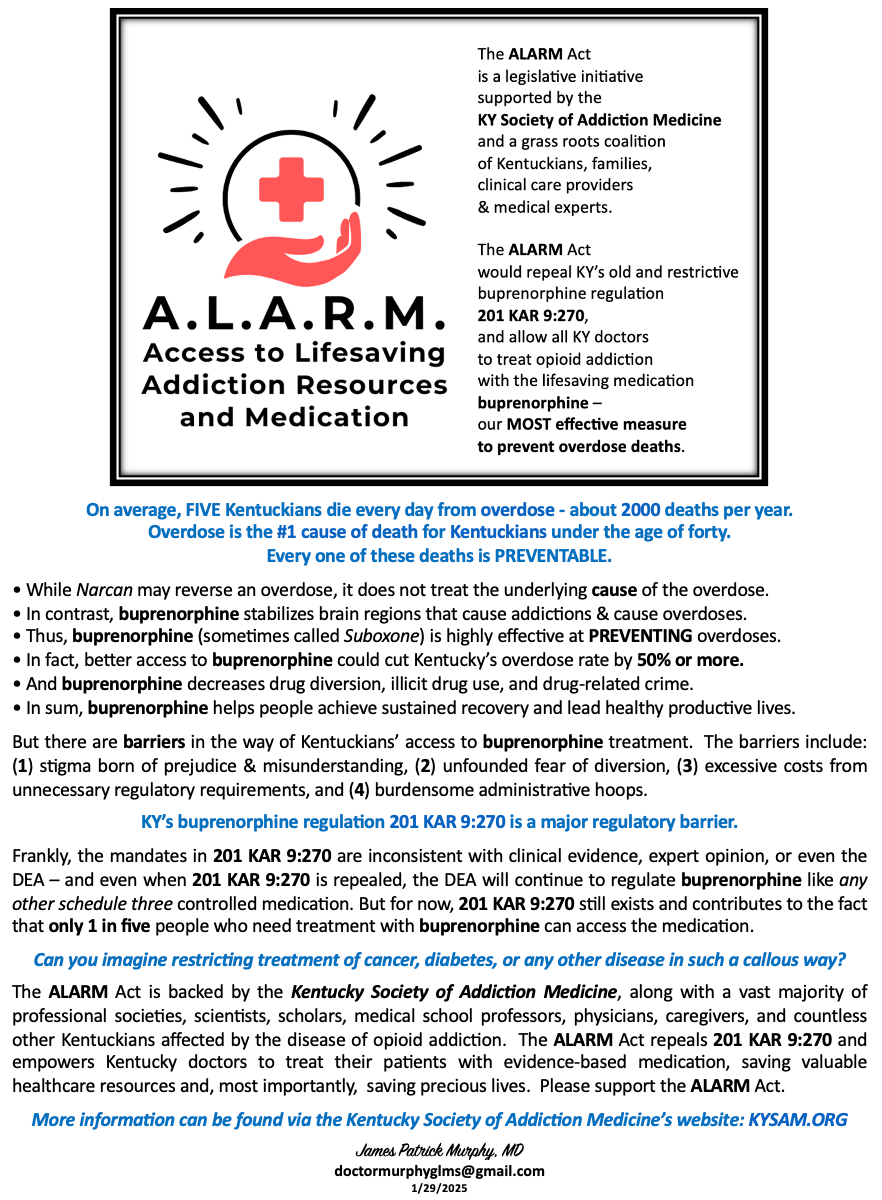
ALARM Act one-page advocacy brief
On average, FIVE Kentuckians die every day from overdose – about 2000 deaths per year.
• In sum, buprenorphine helps people achieve sustained recovery and lead healthy productive lives.
But there are barriersin the way of Kentuckians’ access to buprenorphine treatment. The barriers include: (1) stigma born of prejudice & misunderstanding, (2) unfounded fear of diversion, (3) excessive costs from unnecessary regulatory requirements, and (4) burdensome administrative hoops.
KY’s buprenorphine regulation 201 KAR 9:270 is a major regulatory barrier.
Frankly, the mandates in 201 KAR 9:270 are inconsistent with clinical evidence, expert opinion, or even the DEA – and even when 201 KAR 9:270 is repealed, the DEA will continue to regulate buprenorphine like any other schedule three controlled medication. But for now, 201 KAR 9:270 still exists and contributes to the fact that only1 in fivepeoplewho need treatment with buprenorphine can access the medication.
Can you imagine restricting treatment of cancer, diabetes, or any other disease in such a callous way?
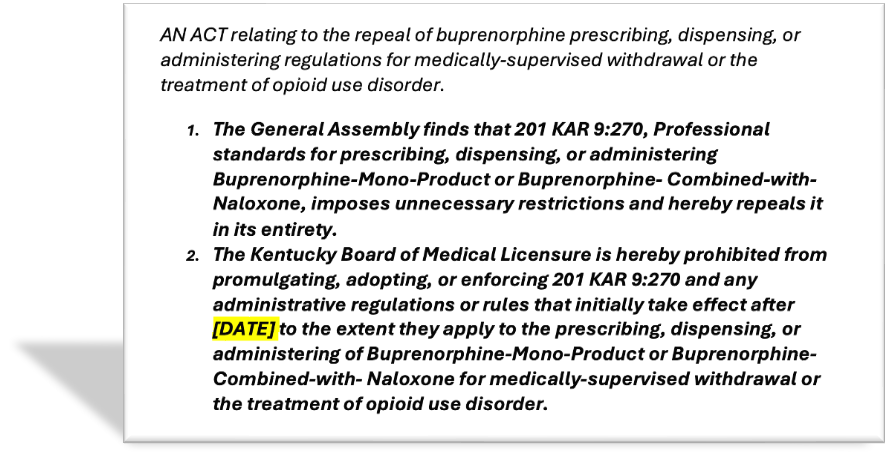
The ALARM Act is backed by the Kentucky Society of Addiction Medicine, along with a vast majority of professional societies, scientists, scholars, medical school professors, physicians, caregivers, and countless other Kentuckians affected by the disease of opioid addiction. The ALARM Act repeals 201 KAR 9:270 and empowers Kentucky doctors to treat their patients with evidence-based medication, saving valuable healthcare resources and, most importantly, saving precious lives. Please support the ALARM Act.
More information can be found via the Kentucky Society of Addiction Medicine’s website: KYSAM.ORG
3/15/2025 UPDATE – For the time being, the ALARM ACT initiative has been merged with HB 788, which was filed by Representative Kim Moser in the Kentucky General Assembly. For more information check out the KYSAM advocacy HB 788 website: https://www.kysam.org/news
Kentucky House Bill 788 supports increased access to buprenorphine by empowering Kentucky’s providers to treat patients with evidence-based care. Check out this 9 minute video of Dr. Murphy’s recent testimony in Kentucky’s capital city: https://www.youtube.com/watch?v=3lILI0x4TXo
The salient issues remain consistent with the ALARM ACT initiative, thus I’m keeping this post on the website to provide historical context supporting our efforts to save lives.
On average, overdose kills five Kentuckians every single day.
There is something simple you can do today to help.
A brief call to your legislators, asking them to support the ALARM Act, could help save thousands of lives.
The ALARM Act is a legislative initiative aimed at improving access to buprenorphine – a lifesaving medication to treat opioid addiction – in fact, buprenorphine is our MOST EFFECTIVE measure to decrease overdoses and overdose deaths. The ALARM Act repeals regulation 201 KAR 9:270 – a decade-old KY law that severely hampers our doctors’ ability to prescribe buprenorphine.
Simply dial (800) 372-7181, and your message will be forwarded to your representatives.
You might say something to the effect of: Please help patients get the lifesaving medicine they need to treat addiction and prevent overdose deaths. Please support Dr. James Patrick Murphy and the Kentucky Society of Addiction Medicine by passing the ALARM Act, which repeal KY’s restrictive buprenorphine regulation 201 KAR 9:270.
Thanks! Now that you know my “ask,” please read on for the rest of the story…
IN RECORD NUMBERS, KENTUCKIANS CONTINUE TO DIE FROM OPIOIDS.
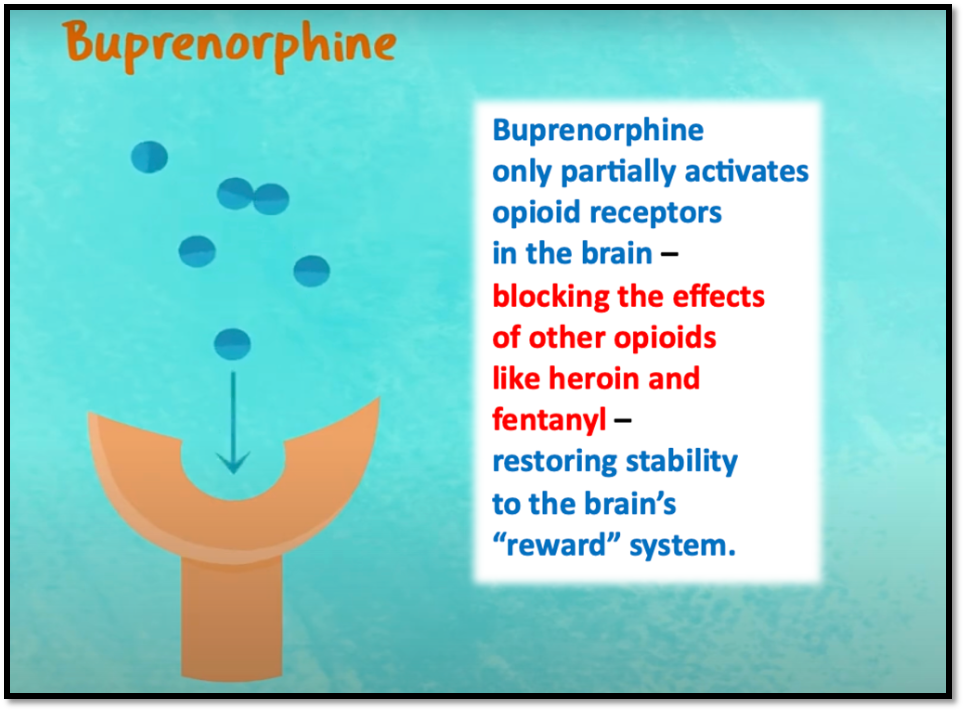
Widespread availability of buprenorphine could decrease overdose deaths by 50% or more. Buprenorphine (sometimes know by the trade name Suboxone) is FDA-approved to treat damaged areas in the brain that cause opioid addiction and can prevent dangerous addictive behaviors that lead to overdose.
Distinct from NARCAN – which might reverse an overdose but does not treat the actual addiction –buprenorphine treats the root cause of the overdose. Buprenorphine promotes recovery, reduces crime, prevents overdoses, and saves lives.
Buprenorphine treatment is not simply trading one drug dependency for another. Quite the opposite, buprenorphine is a prescription medicine that treats the disease process, allowing patients to lead productive heathy lives – in much the same way that insulin allows people with diabetes to manage their disease and live well.
Tragically, barriers to accessing buprenorphine exist, such as regulatory burdens, costs, stigma, and unfounded fear of diversion. Thus, only one in five Kentuckians who need buprenorphine can get treatment.
In Kentucky, a major barrier to buprenorphine treatment is 201 KAR 9:270 – an obsolete law that is not aligned with current clinical evidence. This onerous regulation restricts effective dosing and forces doctors and patients to complete costly, unnecessary tasks and imposes unscientific mandates that contradict recommendations of the overwhelming majority of experts. This is beyond illogical – it’s dangerous and deprives suffering people of lifesaving medication.
Ask yourself, would anyone be OK with treating breast cancer this way? Of course not. So why is Kentucky so restrictive with treating ADDICTION ? – the #1 cause of death for adults under the age of forty.
Kentucky is a an outlier. Our federal government and most other states have already done away with antiquated regulations like 201 KAR 9:270, allowing buprenorphine to be regulated like any other DEA schedule 3 controlled substance – as it should be. But Kentucky, despite ranking among the absolute worst states in terms of overdose deaths, somehow is still hanging on to 201 KAR 9:270. This must change. The regulation must be repealed.
The ALARM Act is a vital grass roots legislative initiative, supported by the Kentucky Society of Addiction Medicine and many others, that will repeal 201 KAR 9:270 and allow all Kentucky doctors to confidently treat their patients with buprenorphine – the “gold standard” medication for treating opioid addiction.
Every overdose death is PREVENTABLE.
Sound the ALARM !
Contact Your Kentucky legislators and ask them to support the ALARM Act.
(800) 372-7181 Monday-Friday 7am to 6pm
or
(502) 564-8100 Monday-Friday 8am to 4:30pm,
And email addresses can be found on their individual bio pages:
Buprenorphine is an FDA-approved medication for treating opioid use disorder, proven to be effective inpreventingoverdose deaths, reducing drug related crime, recidivism, and drug diversion, while saving valuable community resources.
However, Kentucky’s buprenorphine prescribing regulation 201 KAR 9:270 is outdated, unnecessary and harmful, because it creates barriers to accessing this lifesaving care.
Furthermore, despite all good intentions, this regulation paradoxically increases crime and diversion. Thus, for the safety of our communities, 201 KAR 9:270 must be repealed.
• Despite law enforcement, DEA, policy-makers, and medical experts universally calling for the removal of barriers to accessing buprenorphine, barriers continue to exist, e.g., stigma, costs, irrational fear of diversion, prescriber trepidation, and pharmacist and prescriber fear of regulatory scrutiny. 201 KAR 9:270 contributes to all of these barriers.
• 201 KAR 9:270 is a barrier to buprenorphine treatment, because it rigidly mandates actions that should be dependent on individual patient circumstances and prescriber clinical judgment; actions such as: frequent in-person evaluations, mandatory specialist consults, numerous urine drug tests, extensive labs, psychological counseling, outdated dosage limits, and irrational limits on medications for co-occurring conditions. Laws mandating such measures are not supported by scientific evidence, federal policies, or clinical practice guidelines from the American Society of Addiction Medicine.
• Frankly, Kentucky’s buprenorphine law 201 KAR 9:270 is years behind the times. To illustrate just how absurd it has become, consider that Kentucky requires a special DEA “X-Waiver” that doesn’t even exist anymore. On December 29, 2022, in an effort to increase access to buprenorphine, Congress eliminated all buprenorphine-specific federal regulations, e.g., the DEA “X-Waiver,” along with caps on the number of patients per prescriber, prescriber limits, mandated education. But 201 KAR 9:270 still requires prescribers to have the “X-Waiver.”
• In sum, Kentucky has perhaps the most outdated, draconian, and harmful buprenorphine regulation in our nation and is one of only 19 states that still have buprenorphine-specific regulations on their books. And sadly, prescriptions for buprenorphine in Kentucky have only decreased at a time when overdose rates are still at record levels. Repealing 201 KAR 9:270 is common sense.
Why is this so?
Because of rapidly evolving scientific and clinical knowledge, it’s impossible for policymakers to create regulations that strictly tell clinicians how to treat addiction with buprenorphine. Beyond that, Kentucky’s deliberate regulatory process is too slow and renders obsolete any attempt at reworking 201 KAR 9:270 even before the ink dries on the page.
Therefore, to save lives, reduce crime, and improve the health and well-being of our communities, please join the Kentucky Society of Addiction Medicine and support repeal of Kentucky’s buprenorphine regulation 201 KAR 9:270. This decade old law is outdated, unfixable, unnecessary, and harms the people it was intended to help. It mandates actions that are not supported by evidence, actions that inhibit access to treatment, actions that lead to increase drug related crime, and actions that promote fraud, waste, and abuse.
Rather than discourage drug diversion, 201 KAR 9:270 actually worsens drug related crime and diversion. And tragically, Kentuckians struggling with addiction are needlessly dying because of barriers to treatment caused by this law.
Repeal of 201 KAR 9:270 would allow buprenorphine to assume its rightful place in the category of DEA Schedule III medications with low risk, allowing clinicians to prescribe buprenorphine for its legitimate medical purpose in the usual course of sound professional practice. Make our communities safer and healthier. Repeal of 201 KAR 9:270 is critically necessary.
A summation of clinical, social, and scientific evidence, as well as expert opinion and federal policy focusing on DIVERSION, CRIME, and ACCESS:
Treatment with buprenorphine was associated with a REDUCTION IN ARRESTS, via Addiction Medicine, the official journal of ASAM. https://pubmed.ncbi.nlm.nih.gov/30916463/
Any steps taken to minimize buprenorphine DIVERSION and misuse must be careful not to undermine the positive patient and public health benefits gained from expanded treatment access, via University of Kentucky. https://pubmed.ncbi.nlm.nih.gov/25221984/
Barriers to treatment with buprenorphine include “Aggressive enforcement strategies by the DEA and several state attorneys general—including increases in raiding, auditing, and launching criminal investigations of waivered providers,” via National Academies of Science.https://nap.nationalacademies.org/read/25310/chapter/7#120
The Kentucky Medical Association (KMA), American Medical Association, and the American Society of Addiction Medicine (ASAM) support a bill (House Bill 121) that would remove insurance barriers to treatment with buprenorphine. The rationale supporting House Bill 121 (noted below) also supports the Kentucky Society of Addiction Medicine’s call for repeal of 201 KAR 9:270. For context, I encourage you to read the following “one-page” support document from the AMA:
For more information, please go to my blog CONFLUENTIAL TRUTH https://jamespmurphymd.com and start scrolling. Related stories begin with my post on June 28, 2024 about a petition to the Kentucky Board of Medical Licensure…
Buprenorphine is a safe, effective, and life-saving medication for the treatment of people with opioid use disorder. However, due to buprenorphine access barriers, such as Kentucky’s buprenorphine regulation (201 KAR 9:270), buprenorphine is accessed by only approximately one out of five people who need treatment with this medication. 201 KAR 9:270 limits access to life-saving treatment with buprenorphine, worsens the societal impact of the opioid crisis, perpetuates stigma, and harms the people it was intended to help. Considering current scientific evidence, there is no plausible reason a separate buprenorphine-specific regulation, like 201 KAR 9:270, should continue to exist in Kentucky, especially considering our federal government has eliminated more restrictive national buprenorphine-specific regulations.
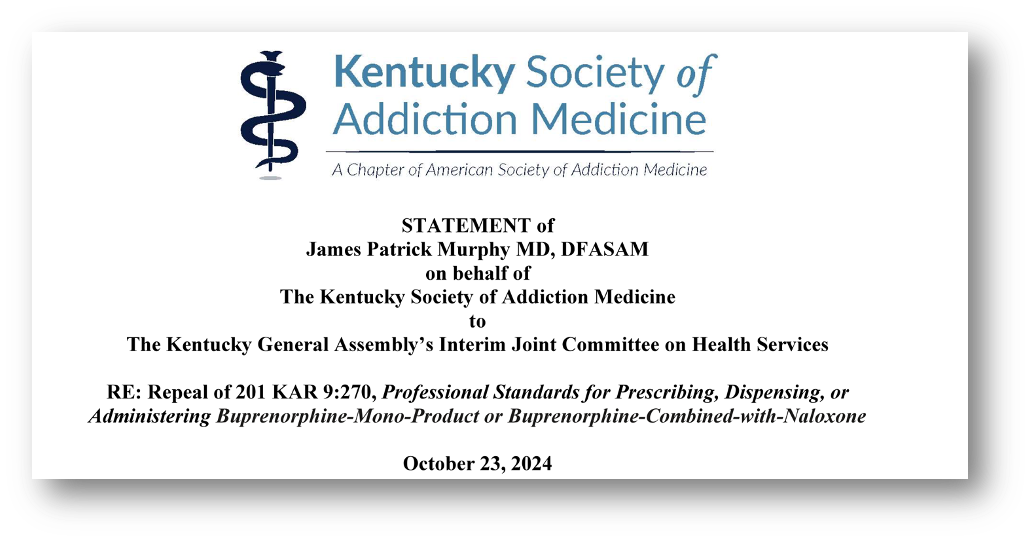
Recently, I was invited to testify in Kentucky’s capital on behalf of my Kentucky Society of Addiction Medicine colleagues regarding KY’s outdated buprenorphine regulation. My televised address to the Kentucky General Assembly’s Interim Joint Committee on Health Services on October 23, 2024 focused on six good reasons 201 KAR 9:270 needs to be repealed.
In truth, working together we can dramatically lower the opioid overdose rate in Kentucky and save thousands of lives each year. But a major barrier standing in our way is Kentucky’s outdated regulation (201 KAR 9:270) that restricts how physicians prescribe buprenorphine to treat patients with the disease of opioid use disorder.
I urge you to learn more about how experts, advocates, and concerned citizens are working to remove this harmful barrier to lifesaving care, by clicking on the links provided below:
So, if you’ve read this far, first of all, THANK YOU! And secondly, you’ll probably be interested in what the Kentucky Board of Medical Licensure had to say following my testimony. The board’s “prepared statement” is only about 4 1/2 minutes, but there’s a lot to unpack here…
These two presentations before the Interim Joint Committee on Health Services represent two distinctly different approaches to a problem — one by caregivers, the other by regulators. Decide for yourself which approach is most vital in this moment of crisis.
Reading a prepared statement, President Thornbury said, “The board must make decisions based on the realities of the Commonwealth, not idealized scenarios.”
Well, the reality is that our young people are dying.
Kentucky’s buprenorphine regulation is outdated, harmful, and unsalvageable. It’s not necessary. And it forces physicians to practice beneath the standard of care. This regulation needs to be repealed, not processed, analyzed, and amended over a period of years. People who could be saved are dying now because of this regulation.
And, by the way, choosing life over death happens to be an “idealized scenario” I’m OK with.
Repealing 201 KAR 9:270 is choosing life.
Let’s make that the reality of our Commonwealth.
In summary…
Kentucky is mired in the throes of a deadly public health emergency, an opioid overdose crisis that has taken the lives of over 26,000 of our neighbors, friends, family members, and loved ones since the year 2000. Buprenorphine, a DEA schedule III controlled medication, has emerged as an essential standard of care for the treatment of opioid use disorder. However since 2015, Kentucky physicians’ efforts to effectively care for patients with addiction have been hampered by a regulation, 201 KAR 9:270, that impedes access to life-saving treatment for Kentuckians most at risk of dying from an overdose. 201 KAR 9:270 forces physicians to practice below the standard of care. This is harmful to the citizens of Kentucky and worsens our state’s opioid crisis. As scholars of addiction treatment policy have explained, no evidence supports the requirements in 201 KAR 9:270, which by preventing access to buprenorphine, allows preventable deaths to occur. Kentuckians are needlessly dying because of this regulation.