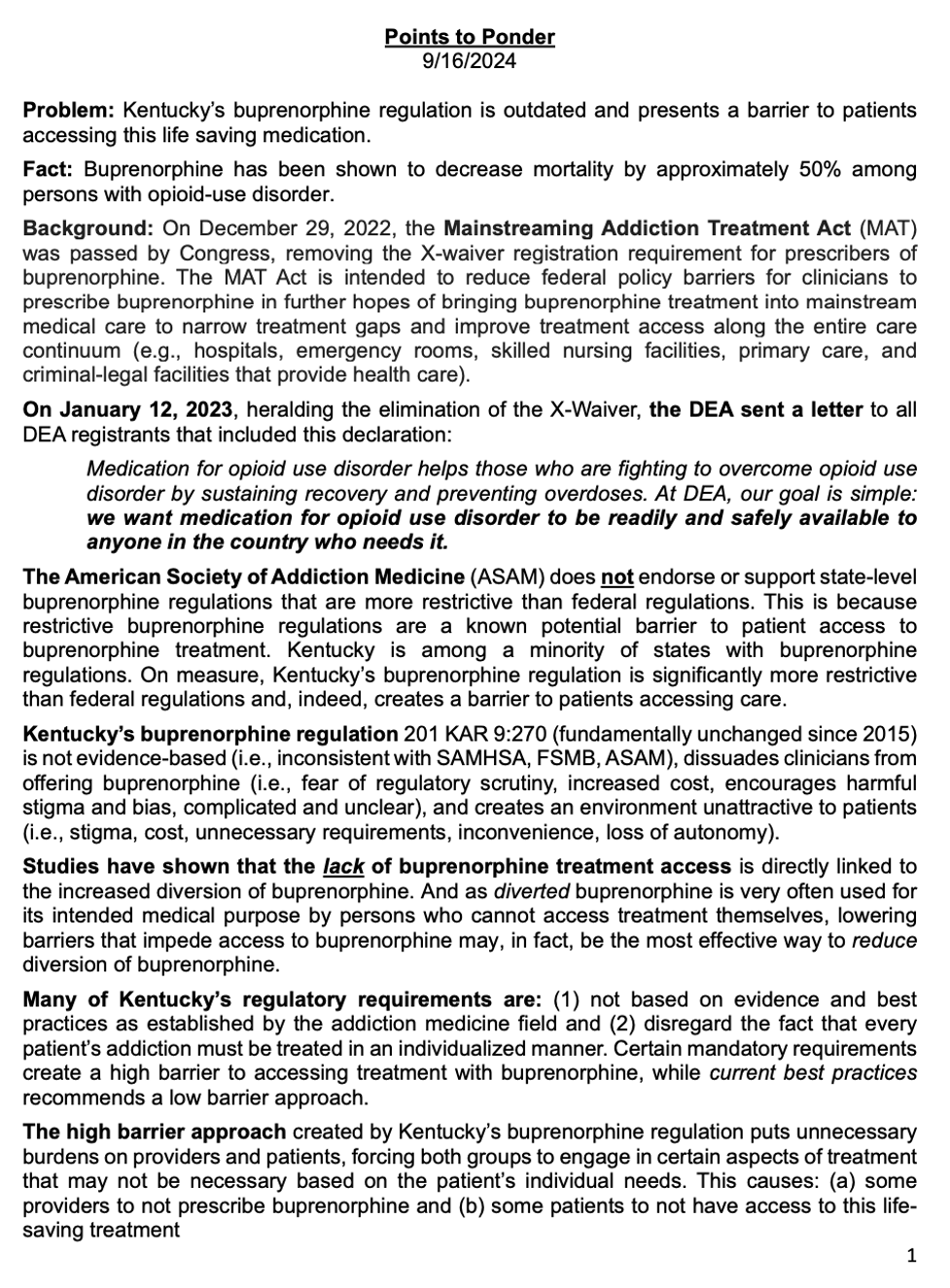
Urgent request! Dr. Murphy is asking you to email KBML by June 27 and call for a halt to 201 KAR 9:270. Eliminating this regulation will save lives! (Post updated on 5/8/2025)

HERE’S THE LATEST: The Kentucky Board of Medical Licensure (KBML) filed their updated version of 201 KAR 9:270 (the buprenorphine regulation) and scheduled an in-person public hearing for March 26, 2025. However, KBML cancelled this hearing due to an overwhelming number of requests by speakers to be heard. KBML has now rescheduled the hearing for June 27, 2025, only this time it’s not in-person. It’s a Zoom meeting! They have not posted the link yet, so stay tuned and monitor the KBML website, link: https://kbml.ky.gov/Pages/index.aspx

Please mark your calendar for June 27th and spread the news. To review, below is a call to action from Dream.org sent prior to the cancelled March 26th hearing – NOW JUNE 27. The same issues are still at stake. Your voice is needed now more than ever! Even if you only Zoom in for thirty seconds. YOUR WRITTEN COMMENTS MATTER TOO! THANK YOU!

Dear Friends, Neighbors, and Colleagues,

Now is the time to take action! Your voice can make a difference in Kentucky. A simple email could help save lives. Here’s how: Send an email to the Kentucky Board of Medical Licensure (KBML) via

Leanne K. Diakov, KBML General Counsel at leanne.diakov@ky.gov

To make it easier, simply click on this LINK, where you’ll find a helpful brief to guide you in crafting and sending your email to leanne.diakov@ky.gov

NOTE: KBML HAS RESCHEDULED THE PUBLIC HEARING FOR JUNE 27, 2025, AND ARE ACCEPTING EMIALS AND WRITTEN COMMENTS THROUGH JUNE 27.

https://mailchi.mp/kypar/take-1-minute-to-make-a-differencesave-lives?e=411f28ea2

Tell KMBL that you do not support the proposed changes Kentucky’s buprenorphine regulation, and you believe Kentucky would be better served by eliminating the entire regulation known as 201 KAR 9:270.

Why is this necessary?

The Kentucky Board of Medical Licensure (KBML) is nearing the final stages of updating the regulation 201 KAR 9:270, which governs the treatment of Opioid Use Disorder with buprenorphine in Kentucky. Even with the proposed changes, this regulation remains flawed and harmful, and KBML has yet to fully acknowledge the impact. You don’t have to take my word for it. Read it for yourself at https://apps.legislature.ky.gov/law/kar/titles/201/009/270/REG/

Unfortunately, KBML’s proposed amendments do not address the damaging, stigmatizing policies first introduced in 2015. But you still have time to help alter this course. Until JUNE 27, you can make your voice heard with an email to KBML.

How did we get here?

Despite input from hundreds of specialists, caregivers, and concerned Kentuckians calling for significant revisions to this harmful regulation, KBML has moved forward with publishing insufficient amendments to their outdated regulations on buprenorphine prescribing. Sadly, these amendments do little to improve the situation and further create barriers for patients seeking this life-saving treatment.

Kentucky is out of sync with the rest of the country. While federal guidelines have simplified and streamlined buprenorphine prescribing in recent years, Kentucky remains one of the few states enforcing stricter, punitive measures. Kentucky’s buprenorphine regulation (and its proposed amendments) are not only unsupported by evidence but also contribute to an increase in overdose deaths by limiting access to care.

If 201 KAR 9:270 and its proposed amendments are allowed to proceed, Kentucky will miss the opportunity to align itself with the latest scientific evidence, expert recommendations, and current federal guidelines. Continuing with Kentucky’s flawed regulation will only result in more preventable overdose deaths in our state.

If you’d like to read the experts’ perspectives, check out this letter from the Kentucky Society of Addiction Medicine to Governor Beshear: KYSAM Advocacy Letter link: https://www.kysam.org/kysam-advocacy

The proposed KBML regulation update includes several provisions that are not evidence-based, such as:

  • Arbitrary dosage limits
  • Mandatory behavioral and psychosocial interventions
  • Inconsistent, compulsory appointment scheduling
  • Non-evidence-based laboratory testing requirements
  • Forced specialist referrals for certain patients
  • A ban on using buprenorphine-naloxone for chronic pain

It’s time to take action!

Now through JUNE 27, you have the opportunity to speak up on behalf of those struggling with opioid use disorder. Email your comments to:

Leanne K. Diakov, KBML General Counselleanne.diakov@ky.gov

At the end of this post, you’ll find a sample letter that you can modify to share your personal perspective, if you wish. Personalizing your message can make a big impact!

Here’s why you should take action now:

  • Overdose is the leading cause of death for Kentuckians under 40.
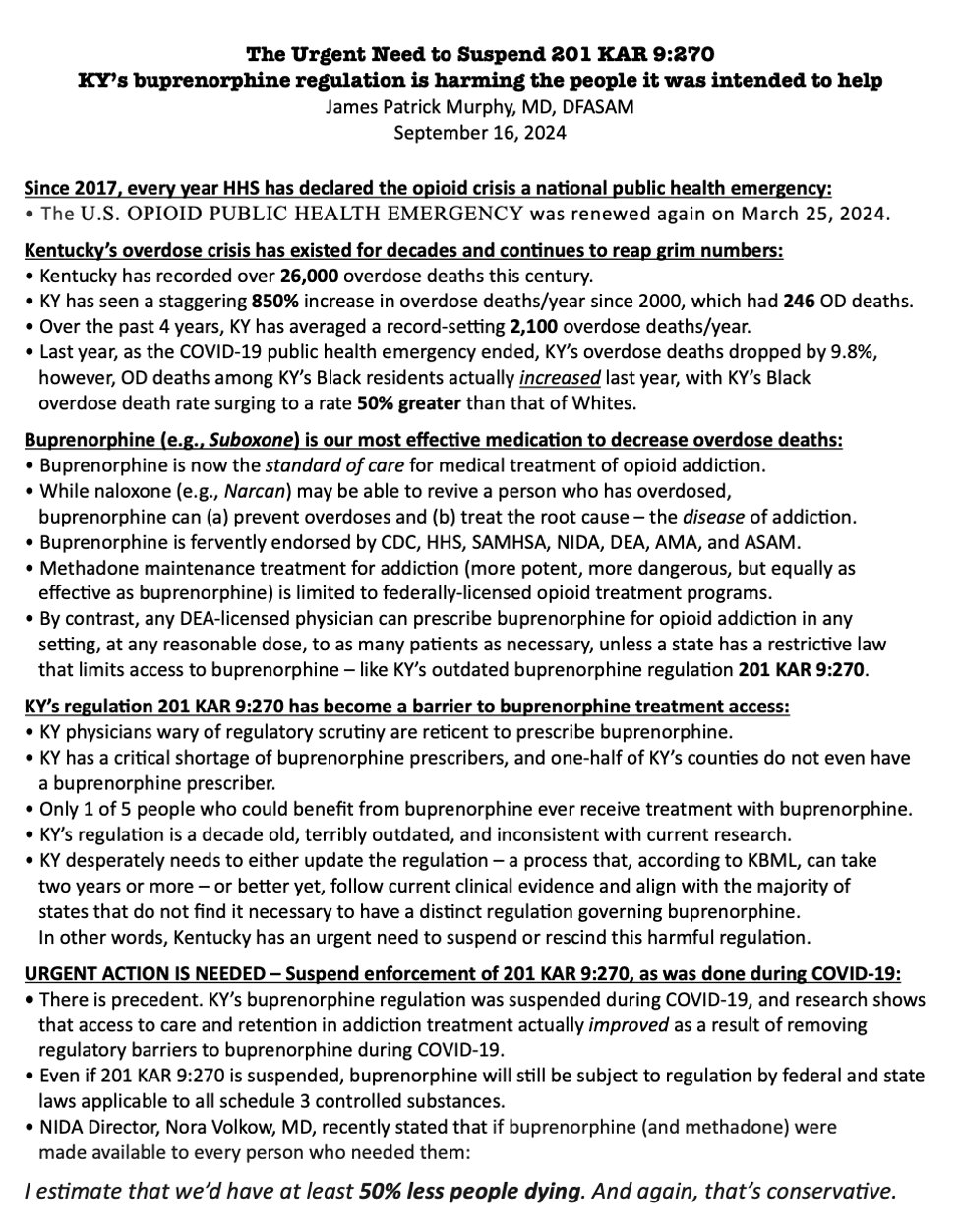
  • The Director of the National Institute on Drug Abuse stated that if everyone who needs buprenorphine could access it, overdose deaths could be reduced by half.
  • 201 KAR 9:270 is a barrier preventing Kentuckians from accessing this life-saving medication.
  • And despite a tsunami of evidence proving the lifesaving effects of this medication, buprenorphine prescribing in Kentucky actually decreased last year! We must do better!

What more motivation do you need? Together, we can make a difference. Let your voice be heard!

Thank you for your support!

Sincerely,
James Patrick Murphy, MD, DFASAM

Dr. Murphy is Kentucky’s Regional Director for the American Society of Addiction Medicine and is a founding member of the American Medical Association’s Substance Use and Pain Care Task Force. He serves as an Assistant Clinical Professor for the University of Louisville School of Medicine and is board-certified in Anesthesiology, Pain Management, and Addiction Medicine.

***SAMPLE TEXT*** 

To:
Kentucky Board of Medical Licensure
Attention: Leanne K. Diakov, General Counsel
Email: leanne.diakov@ky.gov

RE: Public Comments on Proposed Amendments to 201 KAR 9:270

Dear Members of the Kentucky Board of Medical Licensure,

I am submitting my public comments on the proposed amendments to 201 KAR 9:270. Rather than addressing Kentucky’s overdose crisis, I am concerned that these proposed changes will only worsen the situation, creating additional barriers to care and limiting access to critical, lifesaving treatments. I respectfully urge the Board to prioritize evidence-based addiction treatment by rejecting these amendments and fully repealing this outdated and harmful regulation.

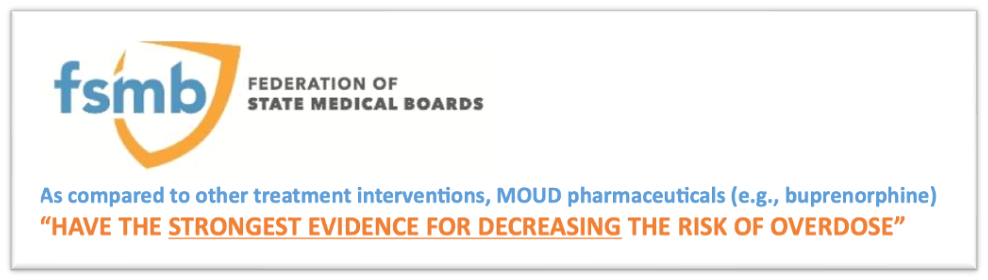
Expanding access to medications for opioid use disorder, such as buprenorphine, is crucial for reducing overdose deaths. Unfortunately, the proposed amendments directly contradict the guidance from several leading authorities, including the U.S. Department of Health and Human Services, the Drug Enforcement Administration, the Substance Abuse and Mental Health Services Administration, the National Institute on Drug Abuse, and the Federation of State Medical Boards, all of which support broader access to buprenorphine-based treatments. The restrictions outlined in 201 KAR 9:270 would be counterproductive and could exacerbate health disparities, especially within marginalized communities.

If these proposed amendments are enacted, 201 KAR 9:270 will continue to contribute to Kentucky’s tragically high overdose death rate. I fully support the concerns raised by the Kentucky Society of Addiction Medicine, which has reviewed the proposed changes and deemed them insufficient. In light of these concerns, I strongly advocate for the full repeal of 201 KAR 9:270.

Thank you for considering the potential impact of these amendments on the health and well-being of Kentuckians. I urge the Board to prioritize evidence-based addiction treatment by rejecting these amendments and fully repealing this outdated and harmful regulation.

Sincerely,
[Your Name]
[Your Credentials/Professional Title, if applicable]
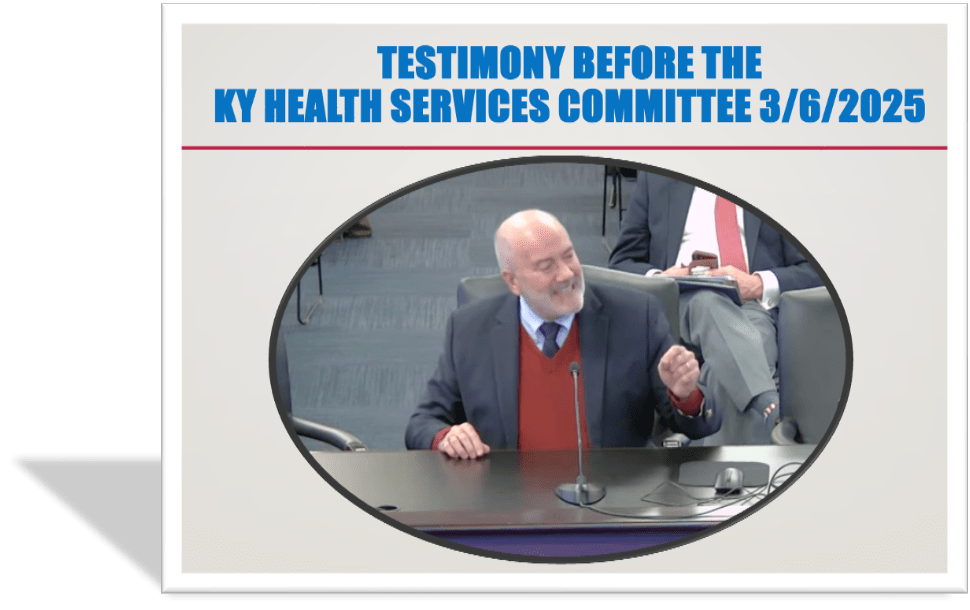
Kentucky House Bill 788 (currently in committee) supports increased access to buprenorphine by empowering Kentucky’s providers to treat patients with evidence-based care. Check out this 9 minute video of Dr. Murphy’s recent testimony in Kentucky’s capital city: https://www.youtube.com/watch?v=3lILI0x4TXo

More and more people and organizations are joining this cause…
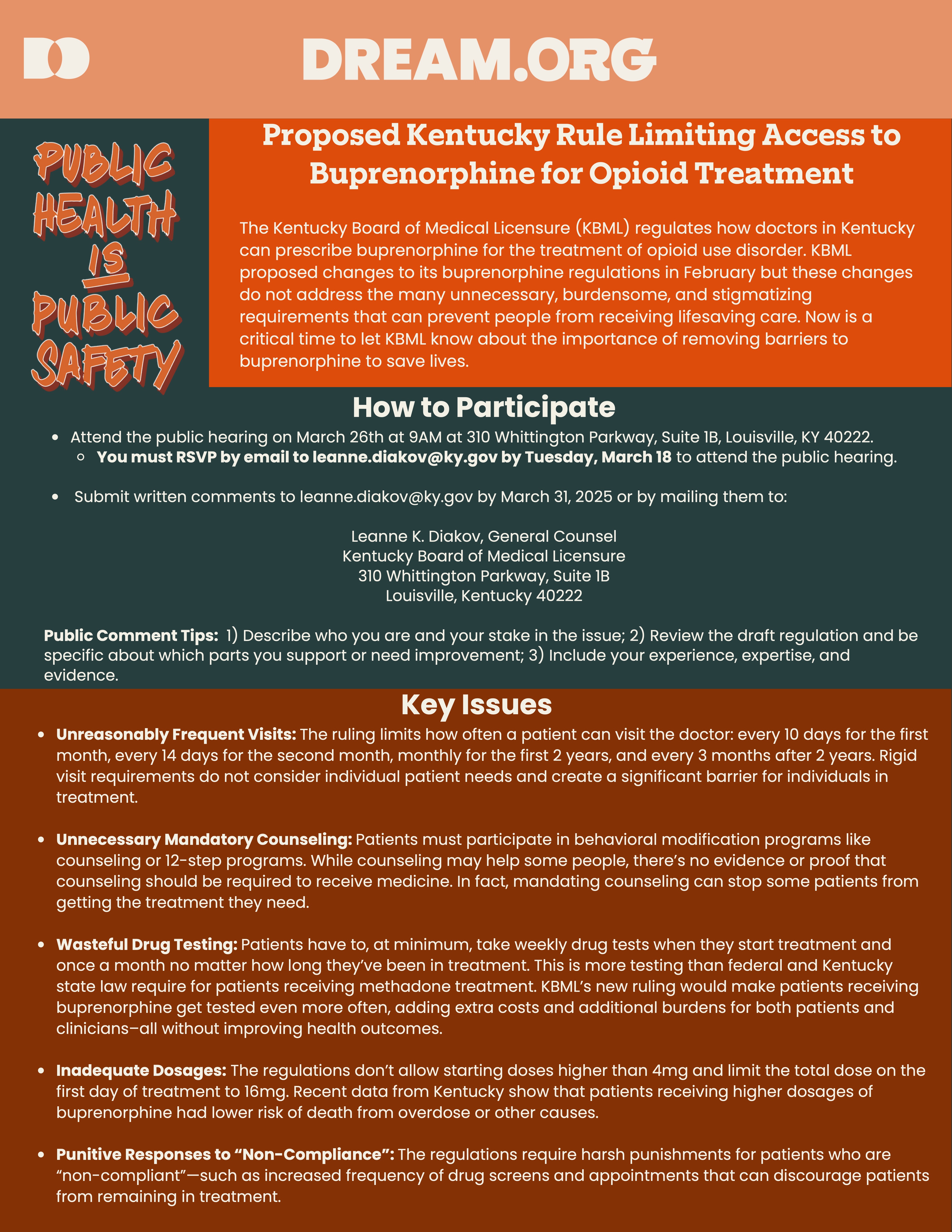
ALARM ACT ONE-PAGE ADVOCACY BRIEF

3/15/2025 UPDATE – For the time being, the ALARM ACT initiative has been merged with HB 788, which was filed by Representative Kim Moser in the Kentucky General Assembly. For more information check out the KYSAM advocacy HB 788 website:  https://www.kysam.org/news

Kentucky House Bill 788 supports increased access to buprenorphine by empowering Kentucky’s providers to treat patients with evidence-based care. Check out this 9 minute video of Dr. Murphy’s recent testimony in Kentucky’s capital city: https://www.youtube.com/watch?v=3lILI0x4TXo

The salient issues remain consistent with the ALARM ACT initiative, thus I’m keeping this post on the website to provide historical context supporting our efforts to save lives.

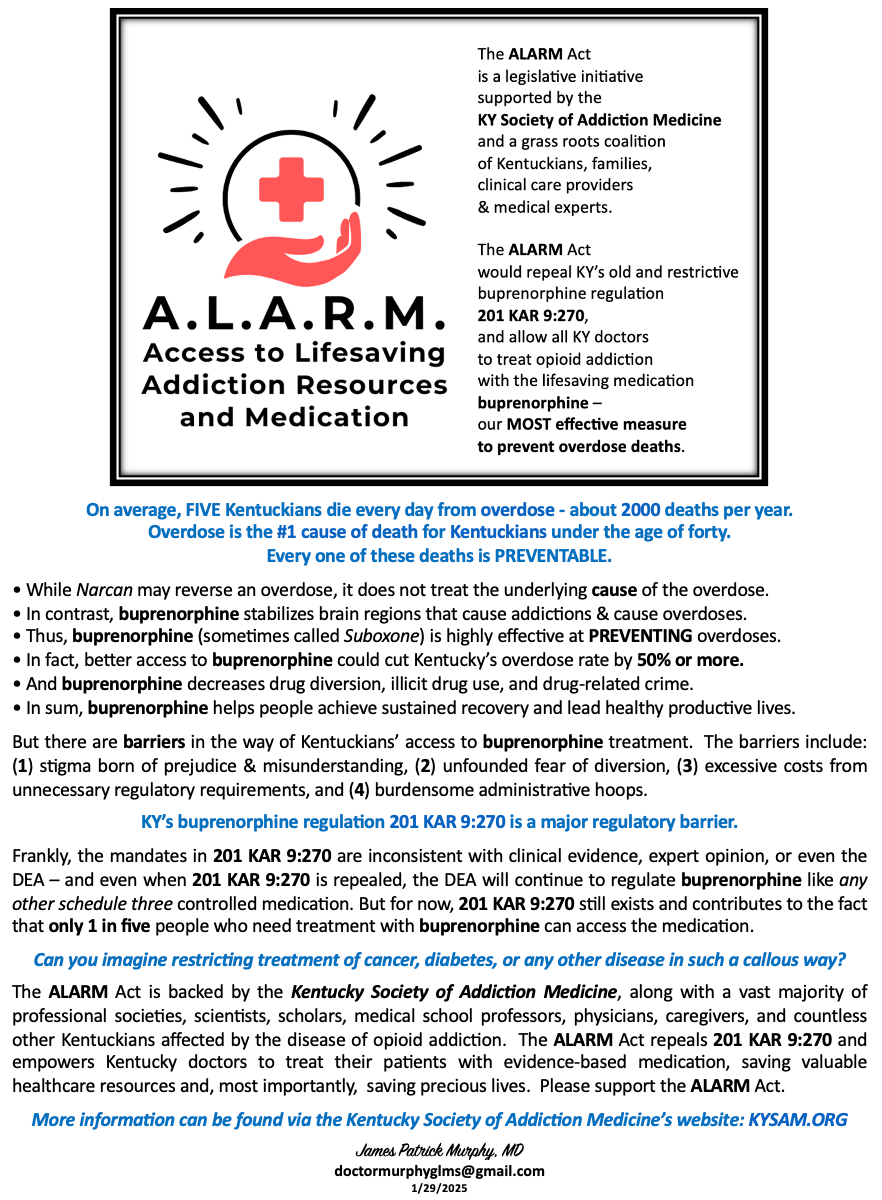
ALARM Act one-page advocacy brief

On average, FIVE Kentuckians die every day from overdose – about 2000 deaths per year.

Overdose is the #1 cause of death for Kentuckians under the age of forty.

Every one of these deaths is PREVENTABLE.

• While Narcan may reverse an overdose, it does not treat the underlying cause of the overdose.

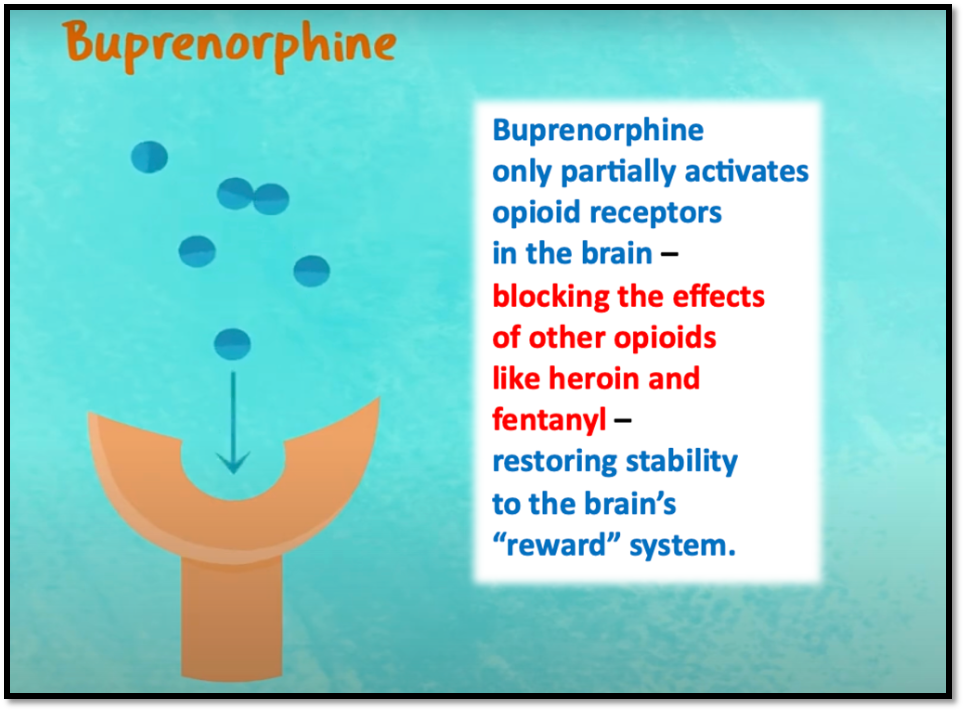
• In contrast, buprenorphine stabilizes brain regions that cause addictions & cause overdoses.

• Thus, buprenorphine (sometimes called Suboxone) is highly effective at PREVENTING overdoses.

• In fact, better access to buprenorphine could cut Kentucky’s overdose rate by 50% or more.

• And buprenorphine decreases drug diversion, illicit drug use, and drug-related crime.

• In sum, buprenorphine helps people achieve sustained recovery and lead healthy productive lives.

But there are barriers in the way of Kentuckians’ access to buprenorphine treatment.  The barriers include: (1stigma born of prejudice & misunderstanding, (2unfounded fear of diversion, (3) excessive costs from unnecessary regulatory requirements, and (4burdensome administrative hoops. 

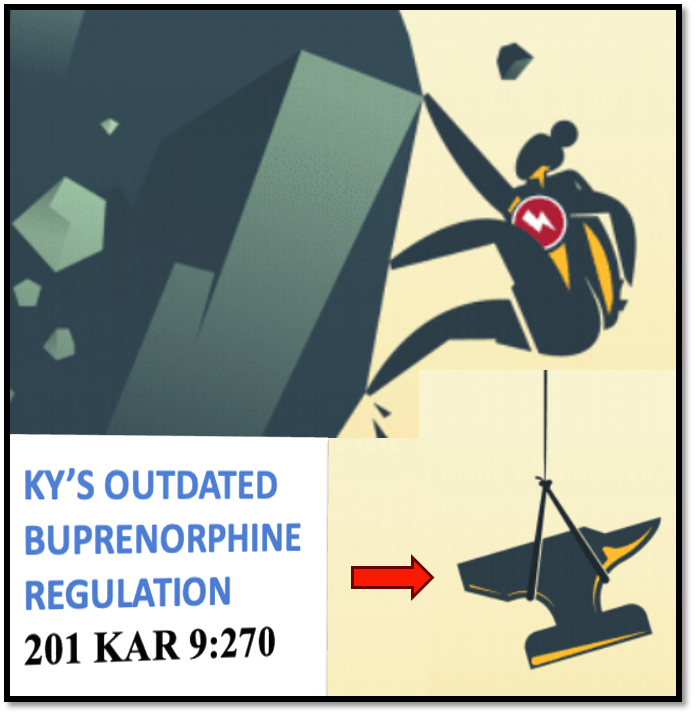
KY’s buprenorphine regulation 201 KAR 9:270 is a major regulatory barrier.

Frankly, the mandates in 201 KAR 9:270 are inconsistent with clinical evidence, expert opinion, or even the DEA – and even when 201 KAR 9:270 is repealed, the DEA will continue to regulate buprenorphine like any other schedule three controlled medication. But for now, 201 KAR 9:270 still exists and contributes to the fact that only 1 in five people who need treatment with buprenorphine can access the medication.

Can you imagine restricting treatment of cancer, diabetes, or any other disease in such a callous way?

The ALARM Act is backed by the Kentucky Society of Addiction Medicine, along with a vast majority of professional societies, scientists, scholars, medical school professors, physicians, caregivers, and countless other Kentuckians affected by the disease of opioid addiction.  The ALARM Act repeals 201 KAR 9:270 and empowers Kentucky doctors to treat their patients with evidence-based medication, saving valuable healthcare resources and, most importantly,  saving precious lives.  Please support the ALARM Act. 

More information can be found via the Kentucky Society of Addiction Medicine’s website: KYSAM.ORG

James Patrick Murphy, MD

doctormurphyglms@gmail.com  

1/29/2025

Sound the ALARM ! 

3/15/2025 UPDATE – For the time being, the ALARM ACT initiative has been merged with HB 788, which was filed by Representative Kim Moser in the Kentucky General Assembly. For more information check out the KYSAM advocacy HB 788 website:  https://www.kysam.org/news

Kentucky House Bill 788 supports increased access to buprenorphine by empowering Kentucky’s providers to treat patients with evidence-based care. Check out this 9 minute video of Dr. Murphy’s recent testimony in Kentucky’s capital city: https://www.youtube.com/watch?v=3lILI0x4TXo

The salient issues remain consistent with the ALARM ACT initiative, thus I’m keeping this post on the website to provide historical context supporting our efforts to save lives.

On average, overdose kills five Kentuckians every single day.

There is something simple you can do today to help.

A brief call to your legislators, asking them to support the ALARM Act, could help save thousands of lives.

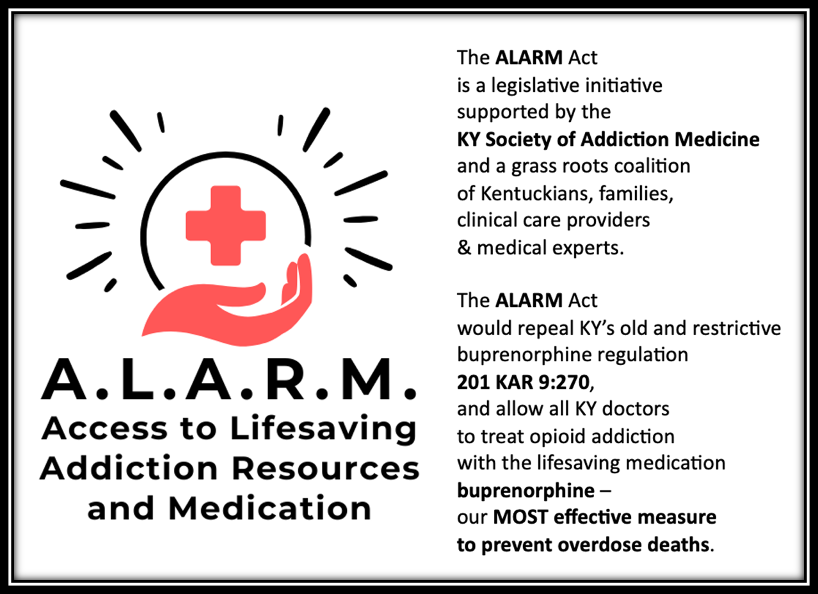
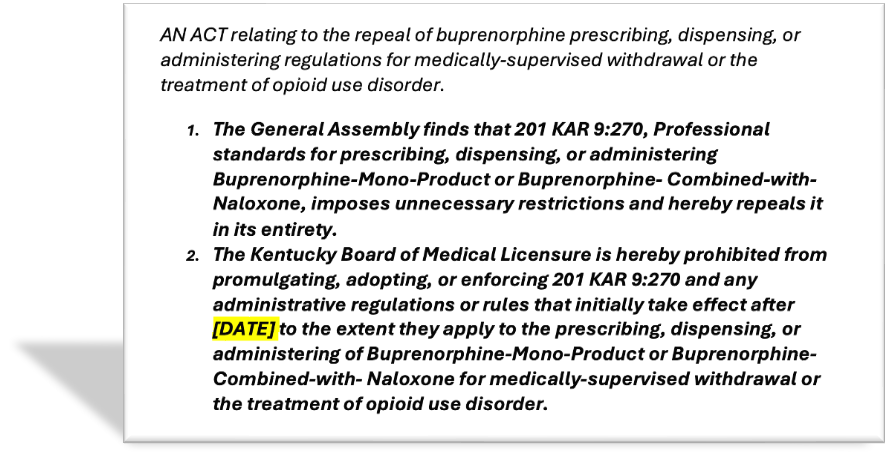
The ALARM Act is a legislative initiative aimed at improving access to buprenorphine – a lifesaving medication to treat opioid addiction – in fact, buprenorphine is our MOST EFFECTIVE measure to decrease overdoses and overdose deaths. The ALARM Act repeals regulation 201 KAR 9:270 – a decade-old KY law that severely hampers our doctors’ ability to prescribe buprenorphine.

Simply dial (800) 372-7181, and your message will be forwarded to your representatives.

You might say something to the effect of: Please help patients get the lifesaving medicine they need to treat addiction and prevent overdose deaths. Please support Dr. James Patrick Murphy and the Kentucky Society of Addiction Medicine by passing the ALARM Act, which repeal KY’s restrictive buprenorphine regulation 201 KAR 9:270.

Thanks! Now that you know my “ask,” please read on for the rest of the story

IN RECORD NUMBERS, KENTUCKIANS CONTINUE TO DIE FROM OPIOIDS.

Widespread availability of buprenorphine could decrease overdose deaths by 50% or more. Buprenorphine (sometimes know by the trade name Suboxone) is FDA-approved to treat damaged areas in the brain that cause opioid addiction and can prevent dangerous addictive behaviors that lead to overdose.

Distinct from NARCAN – which might reverse an overdose but does not treat the actual addiction –buprenorphine treats the root cause of the overdose. Buprenorphine promotes recovery, reduces crime, prevents overdoses, and saves lives.

Buprenorphine treatment is not simply trading one drug dependency for another. Quite the opposite, buprenorphine is a prescription medicine that treats the disease process, allowing patients to lead productive heathy lives – in much the same way that insulin allows people with diabetes to manage their disease and live well.

Tragically, barriers to accessing buprenorphine exist, such as regulatory burdens, costs, stigma, and unfounded fear of diversion. Thus, only one in five Kentuckians who need buprenorphine can get treatment.

In Kentucky, a major barrier to buprenorphine treatment is 201 KAR 9:270 – an obsolete law that is not aligned with current clinical evidence. This onerous regulation restricts effective dosing and forces doctors and patients to complete costly, unnecessary tasks and imposes unscientific mandates that contradict recommendations of the overwhelming majority of experts. This is beyond illogical – it’s dangerous and deprives suffering people of lifesaving medication.

Ask yourself, would anyone be OK with treating breast cancer this way? Of course not. So why is Kentucky so restrictive with treating ADDICTION ? – the #1 cause of death for adults under the age of forty.

Kentucky is a an outlier. Our federal government and most other states have already done away with antiquated regulations like 201 KAR 9:270, allowing buprenorphine to be regulated like any other DEA schedule 3 controlled substance – as it should be. But Kentucky, despite ranking among the absolute worst states in terms of overdose deaths, somehow is still hanging on to 201 KAR 9:270. This must change. The regulation must be repealed.

The ALARM Act is a vital grass roots legislative initiative, supported by the Kentucky Society of Addiction Medicine and many others, that will repeal 201 KAR 9:270 and allow all Kentucky doctors to confidently treat their patients with buprenorphine – the “gold standard” medication for treating opioid addiction.

Every overdose death is PREVENTABLE.

Sound the ALARM !

Contact Your Kentucky legislators and ask them to support the ALARM Act.

(800) 372-7181 Monday-Friday 7am to 6pm

or

(502) 564-8100 Monday-Friday 8am to 4:30pm,

And email addresses can be found on their individual bio pages:

Senators

Representatives

Ask them to help save lives by joining you in supporting the Kentucky ALARM Act.

James Patrick Murphy, MD, DFASAM

Email: doctormurphyglms@gmail.com

Repealing Kentucky’s buprenorphine regulation will decrease crime…and save lives.

Buprenorphine is an FDA-approved medication for treating opioid use disorder, proven to be effective in preventing overdose deaths, reducing drug related crime, recidivism, and drug diversion, while saving valuable community resources.

However, Kentucky’s buprenorphine prescribing regulation 201 KAR 9:270 is outdated, unnecessary and harmful, because it creates barriers to accessing this lifesaving care.

Furthermore, despite all good intentions, this regulation paradoxically increases crime and diversion. Thus, for the safety of our communities, 201 KAR 9:270 must be repealed.

• Eliminating 201 KAR 9:270 is a simple way to increase access to buprenorphine, fight crime, and save money. More importantly, Kentucky’s overdose death rate could potentially be cut in half if every Kentuckian who needs buprenorphine could get.

• Despite law enforcement, DEA, policy-makers, and medical experts universally calling for the removal of barriers to accessing buprenorphine, barriers continue to exist, e.g., stigma, costs, irrational fear of diversion, prescriber trepidation, and pharmacist and prescriber fear of regulatory scrutiny. 201 KAR 9:270 contributes to all of these barriers.

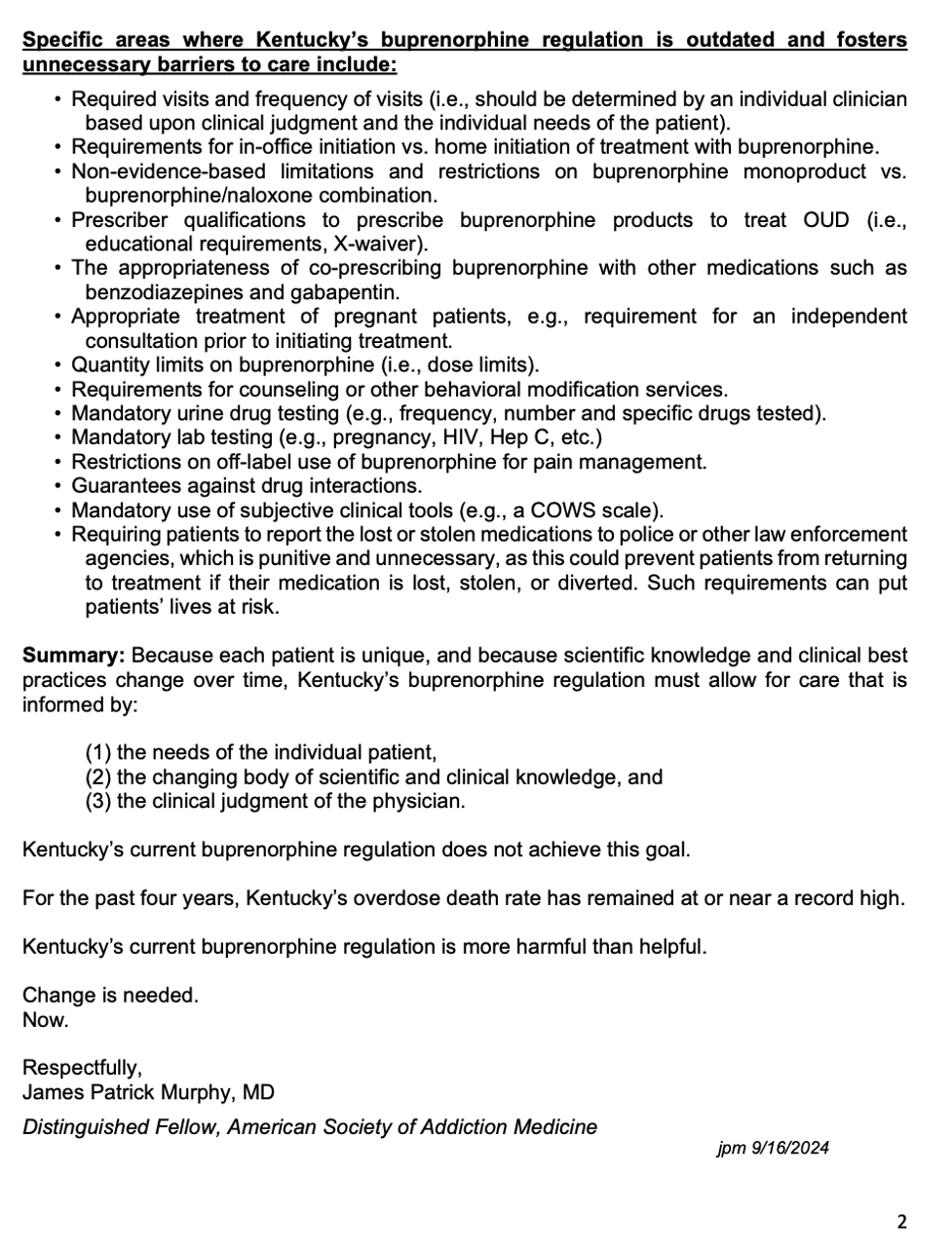
• 201 KAR 9:270 is a barrier to buprenorphine treatment, because it rigidly mandates actions that should be dependent on individual patient circumstances and prescriber clinical judgment; actions such as: frequent in-person evaluations, mandatory specialist consults, numerous urine drug tests, extensive labs, psychological counseling, outdated dosage limits, and irrational limits on medications for co-occurring conditions. Laws mandating such measures are not supported by scientific evidence, federal policies, or clinical practice guidelines from the American Society of Addiction Medicine.

• Frankly, Kentucky’s buprenorphine law 201 KAR 9:270 is years behind the times. To illustrate just how absurd it has become, consider that Kentucky requires a special DEA “X-Waiver” that doesn’t even exist anymore. On December 29, 2022, in an effort to increase access to buprenorphine, Congress eliminated all buprenorphine-specific federal regulations, e.g., the DEA “X-Waiver,” along with caps on the number of patients per prescriber, prescriber limits, mandated education. But 201 KAR 9:270 still requires prescribers to have the “X-Waiver.”

• In sum, Kentucky has perhaps the most outdated, draconian, and harmful buprenorphine regulation in our nation and is one of only 19 states that still have buprenorphine-specific regulations on their books. And sadly, prescriptions for buprenorphine in Kentucky have only decreased at a time when overdose rates are still at record levels. Repealing 201 KAR 9:270 is common sense.

Why is this so?

Because of rapidly evolving scientific and clinical knowledge, it’s impossible for policymakers to create regulations that strictly tell clinicians how to treat addiction with buprenorphine. Beyond that, Kentucky’s deliberate regulatory process is too slow and renders obsolete any attempt at reworking 201 KAR 9:270 even before the ink dries on the page.

Therefore, to save lives, reduce crime, and improve the health and well-being of our communities, please join the Kentucky Society of Addiction Medicine and support repeal of Kentucky’s buprenorphine regulation 201 KAR 9:270. This decade old law is outdated, unfixable, unnecessary, and harms the people it was intended to help. It mandates actions that are not supported by evidence, actions that inhibit access to treatment, actions that lead to increase drug related crime, and actions that promote fraud, waste, and abuse.

Rather than discourage drug diversion, 201 KAR 9:270 actually worsens drug related crime and diversion. And tragically, Kentuckians struggling with addiction are needlessly dying because of barriers to treatment caused by this law.

Repeal of 201 KAR 9:270 would allow buprenorphine to assume its rightful place in the category of DEA Schedule III medications with low risk, allowing clinicians to prescribe buprenorphine for its legitimate medical purpose in the usual course of sound professional practice. Make our communities safer and healthier. Repeal of 201 KAR 9:270 is critically necessary.

A summation of clinical, social, and scientific evidence, as well as expert opinion and federal policy focusing on DIVERSION, CRIME, and ACCESS:

  1. Buprenorphine DIVERSION is driven by those who lack a prescription, and the risks associated with diversion of buprenorphine are outweighed by the risks of denying patients access to buprenorphinevia Prosecutor’s Office, Washtenaw County, MI. https://www.washtenaw.org/DocumentCenter/View/30331/Law-Enforcement-Leaders-Comment-Re-RIN-1117-AB78
  2. Failing to access buprenorphine treatment was the strongest predictor of buprenorphine DIVERSIONvia University of Kentucky. https://pmc.ncbi.nlm.nih.gov/articles/PMC3449053/
  3. Increasing buprenorphine access is an urgent priority to reduce the likelihood of buprenorphine, DIVERSION, overdose and deathvia joint UofL and UK study in Appalachia region. https://www.sciencedirect.com/science/article/abs/pii/S0376871620300028?via%3Dihub
  4. Treatment with buprenorphine was associated with a REDUCTION IN ARRESTSvia Addiction Medicine, the official journal of ASAM. https://pubmed.ncbi.nlm.nih.gov/30916463/
  5. Substance use service presence, including buprenorphine treatment, predicts REDUCTIONS in serious violent CRIMES, burglaries, and motor vehicle THEFTSvia University of Pittsburgh. https://www.sciencedirect.com/science/article/abs/pii/S0955395924000148?via%3Dihub
  6. Incarcerated adults with opioid use disorder who received buprenorphine had a REDUCED likelihood of being ARRESTED or returning to jail or prison after releasevia University of Massachusetts study. https://pmc.ncbi.nlm.nih.gov/articles/PMC8852331/pdf/nihms-1768879.pdf
  7. A misplaced fear of DIVERSION should not limit access to buprenorphinevia U.S. Congressional leadership. https://kuster.house.gov/uploadedfiles/dea_letter_buprenorphine.pdf
  8. The risk of buprenorphine misuse and DIVERSION is lowvia U.S. Dept. of Health and Human Serviceshttps://oig.hhs.gov/reports/all/2023/the-risk-of-misuse-and-diversion-of-buprenorphine-for-opioid-use-disorder-in-medicare-part-d-continues-to-appear-low-2022/
  9. Any steps taken to minimize buprenorphine DIVERSION and misuse must be careful not to undermine the positive patient and public health benefits gained from expanded treatment accessvia University of Kentucky. https://pubmed.ncbi.nlm.nih.gov/25221984/
  10. DIVERSION of buprenorphine is actually associated with a reduction in overdose deathsvia Wayne State Universityhttps://behaviorhealthjustice.wayne.edu/ote/diversion_brief_7_20.pdf
  11. Increasing access to evidence-based treatment may be the most effective policy solution to reduce DIVERSIONvia American Society of Addiction Medicine. https://www.asam.org/docs/default-source/public-policy-statements/statement-on-regulation-of-obot.pdf
  12. Buprenorphine “misuse” is associated with self-treatment of opioid withdrawal and lack of access to treatmentvia Center on Alcohol, Substance Use and Addictions. https://hsc.unm.edu/medicine/research/swctn/_pdfs/bupe-fact-sheet.pdf
  13. There is an “urgent public health need for continued access to buprenorphine as medication for opioid use disorder in the context of the continuing opioid public health crisis,” via DEA 21 CFR Part 1307 (11/19/2024).  https://www.federalregister.gov/documents/2024/11/19/2024-27018/third-temporary-extension-of-covid-19-telemedicine-flexibilities-for-prescription-of-controlled
  14. “There are no longer any limits or patient caps on the number of patients a prescriber may treat for opioid use disorder with buprenorphine,” via U.S. D.O.J., Drug Enforcement Administration https://www.deadiversion.usdoj.gov/pubs/docs/A-23-0020-Dear-Registrant-Letter-Signed.pdf
  15. Barriers to treatment with buprenorphine include “Aggressive enforcement strategies by the DEA and several state attorneys general—including increases in raiding, auditing, and launching criminal investigations of waivered providers,” via National Academies of Science. https://nap.nationalacademies.org/read/25310/chapter/7#120
  16. Policymakers must address regulatory policies that inhibit low barrier buprenorphine treatment, which improves outcomes for individuals, as well as communities, affected by substance use disordersvia Substance Abuse and Mental Health Services Administration. https://store.samhsa.gov/sites/default/files/advisory-low-barrier-models-of-care-pep23-02-00-005.pdf
  17. Low-barrier buprenorphine treatment not only expands access to more patients, but it does so equitablyvia Beasley School of Law, Temple University. https://phlr.org/content/legal-barriers-buprenorphine-vital-tool-managing-recovery-and-preventing-opioid-overdose
  18. Sadly, despite the elimination of all buprenorphine-specific federal regulation and the wealth of quality evidence of the life-saving and crime-reducing benefits of buprenorphine, dispensing of buprenorphine in KY actually decreased by 5.6% from 2022 to 2023, via AMA. https://end-overdose-epidemic.org/wp-content/uploads/2024/11/AMA-2024-Advocacy-Epidemic-report-buprenorphine-IQVIA_FINAL.pdf
  19. The AMA has called upon states to review their laws and other policies to ensure that they remove barriers to buprenorphine treatmentvia AMA Overdose Epidemic Report 2024. https://end-overdose-epidemic.org/highlights/ama-reports/2024-report/
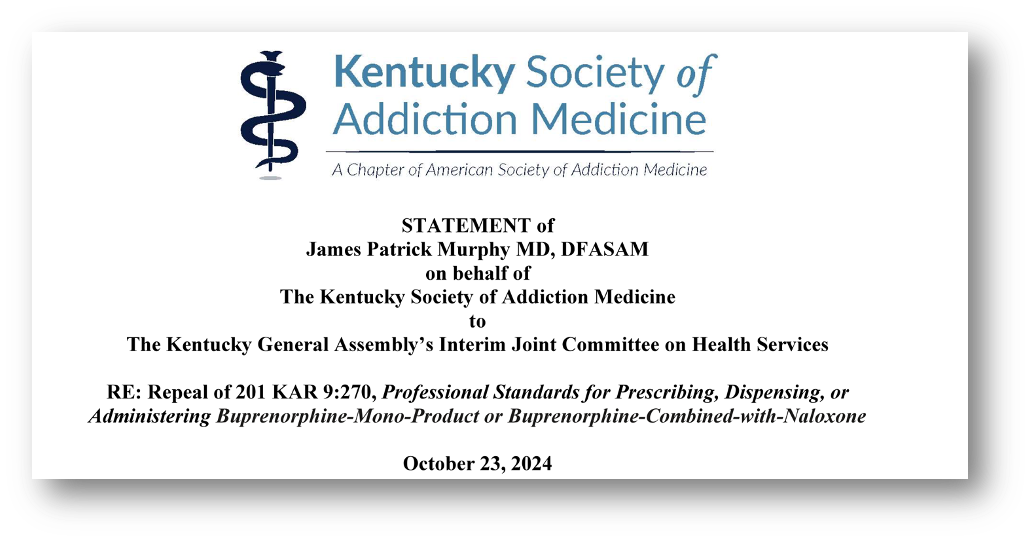
  20. Because KY’s regulation 201 KAR 9:270 is a recognized barrier to Kentuckians’ access to treatment with buprenorphine, the Kentucky Society of Addiction Medicine is calling for the repeal of this outdated, unnecessary, and harmful regulationvia KYSAM. https://apps.legislature.ky.gov/CommitteeDocuments/366/30824/10%2023%202024%204.%20Murphy%20-%20KSAM%20Statement.pdf

Barriers to care caused by 201 KAR 9:270 include:

The Urgent Need

Points to ponder…

A bill to increase access to buprenorphine is not a new idea.

The Kentucky Medical Association (KMA), American Medical Association, and the American Society of Addiction Medicine (ASAM) support a bill (House Bill 121) that would remove insurance barriers to treatment with buprenorphine. The rationale supporting House Bill 121 (noted below) also supports the Kentucky Society of Addiction Medicine’s call for repeal of 201 KAR 9:270. For context, I encourage you to read the following “one-page” support document from the AMA:

For more information, please go to my blog CONFLUENTIAL TRUTH https://jamespmurphymd.com and start scrolling. Related stories begin with my post on June 28, 2024 about a petition to the Kentucky Board of Medical Licensure…

Plan to THINK… How to prescribe controlled substances in Kentucky for the first three months

64-100-10459-2Kentucky’s controlled substances regulations make clear distinctions between: (1) initial prescribing, (2) prescribing by the three-month mark, and (3) prescribing beyond three months. To make matters even more confusing, the regulations are two-tiered, with specific language pertaining only to schedule II drugs, with schedule V drugs being exempt from the regulations.

Because of some seemingly redundant and contradictory language, understanding Kentucky’s regulations can be challenging. Prescriber uncertainty can interfere with proper patient care. In an effort to simplify this process I have summarized Kentucky’s regulations governing the initial prescribing of controlled substances in a convenient “check list” format. Future articles will look at the three-month mark and beyond.

bigstock-doctor-using-a-digital-tablet-31270601-329x196

The bold components of the checklist are required only when prescribing schedule II controlled substances. However, to be safe I recommend checking off all of the requirements when prescribing any schedule II-IV drug.

Note: I am a physician; not a lawyer. This summary is not legal advice. Each facility and physician should consult its own legal counsel for advice and guidance.

Screen Shot 2015-06-04 at 3.12.23 PM

P lan to T H I N K

What to do initially when prescribing during the first three months of treatment.

P lan

___ Deliberate decision that it is medically appropriate to prescribe or dispense the controlled substance in the amount specified

___ Written plan stating the objectives of the treatment

____Written plan stating any further diagnostic examinations                 


T each

___ Safe use

___ A controlled substance for an acute complaint is for time-limited use

___ Discontinue medication when the condition has resolved

___ Proper disposal of any unused medications

___ KBML website resources

Note: Educational materials relating to these subjects may be found on the board’s web site, www.kbml.ky.gov or
 http://kbml.ky.gov/hb1/Pages/Considerations-For-Patient-Education.aspx


H istory and physical

___ Appropriate medical history relevant to the medical complaint, including a history of present illness

___ Physical examination of the patient relevant to the medical complaint and related symptoms

I nformed consent

__ Discuss the benefits and risks of prescribing or dispensing a controlled substance to the patient, including:

(a) nontreatment, (b) other treatment, (c) the risk of tolerance and (d) the risk of drug dependence

__ Obtain written consent for the treatment.

o  long-acting opioids

___ No long-acting or controlled-release opioids for acute pain that is not directly related to and “close in time” to a specific surgical procedure

K ASPER

___ Obtain and review KASPER report for that patient for the preceding 12 months

___ Appropriately utilize KASPER information in evaluation and treatment

Additional documentation required for patient prescribed a schedule II controlled substance, as “appropriate”:

___Diagnostics (labs, studies, etc.)

___Evaluations and consultations;

___Treatments and outcomes

___Medications (date, type, dosage, and quantity)

___Instructions

___Agreements


When prescribing “additional” Schedule II, at “reasonable” and individualized intervals review:

___ Plan of care

___ Provide any new information about the treatment

___ Modify or terminate the treatment as appropriate

EXEMPTIONS to Kentucky’s regulations:

The exemptions are very confusing. While the first set of exemptions (see below) are supposed to apply to all controlled substance, there are additional exemptions that pertain only to schedule II controlled substances.

I believe the most important points here are:

  1. Cancer patients are exempted.
  2. In-patients are exempted for Schedule III-IV
  3. In-patients receiving schedule II drugs must have a KASPER, but all the treating physicians can share the report.
  4. Post-op schedule II drugs are exempted for 2 weeks.
  5. Schedule V drugs are always exempted. 

Here are the exemptions in detail:

Kentucky’s regulations shall not apply to a physician prescribing or dispensing a controlled substance:

(a) To a patient as part of the patient’s hospice or end-of-life treatment;

(b) To a patient admitted to a licensed hospital as an inpatient, outpatient, or observation patient, during and as part of a normal and expected part of the patient’s course of care at that hospital;

(c) To a patient for the treatment of pain associated with cancer or with the treatment of cancer;

(d) To a patient who is a registered resident of a long-term-care facility as defined in KRS 216.510;

(e) During the effective period of any period of disaster or mass casualties which has a direct impact upon the physician’s practice;

(f) In a single dose prescribed or dispensed to relieve the anxiety, pain, or discomfort experienced by that patient submitting to a diagnostic test or procedure; or

(g) That has been classified as a Schedule V controlled substance.

But wait! There are more exemptions that pertain only when prescribing Schedule II controlled substances…

For each patient for whom a physician prescribes or dispenses a Schedule II these regulations shall not apply to:

  • A physician prescribing or administering that controlled substance immediately prior to, during, or within the fourteen (14) days following an operative or invasive procedure or a delivery if the prescribing or administering is medically related to the operative or invasive procedure or delivery and the medication usage does not extend beyond the fourteen (14) days; or
  • For administration in a hospital or long-term-care facility if the hospital or long-term-care facility with an institutional account, or a physician in those hospitals or facilities if no institutional account exists, queries KASPER for all available data on the patient or resident for the twelve (12) month period immediately preceding the query, within twelve (12) hours of the patient’s or resident’s admission, and places a copy of the query in the patient’s or resident’s medical records for use during the duration of the patient’s stay at the facility;
  • As part of the patient’s hospice or end-of-life treatment;
  • For the treatment of pain associated with cancer or with the treatment of cancer;
  • In a single dose to relieve the anxiety, pain, or discomfort experienced by a patient submitting to a diagnostic test or procedure;
  • Within seven (7) days of an initial prescribing or dispensing under subsection (1) of this section if the prescribing or dispensing:
    1. Is done as a substitute for the initial prescribing or dispensing;
    2. Cancels any refills for the initial prescription; and
    3. Requires the patient to dispose of any remaining unconsumed medication;
  • Within ninety (90) days of an initial prescribing or dispensing under subsection (1) of this section if the prescribing or dispensing is done by another physician in the same practice or in an existing coverage arrangement, if done for the same patient for the same medical condition; or
  • To a research subject enrolled in a research protocol approved by an institutional review board that has an active federalwide assurance number from the United States Department for Health and Human Services, Office for Human Research Protections if the research involves single, double, or triple blind drug administration or is additionally covered by a certificate of confidentiality from the National Institutes of Health.

There are additional “Professional Standards for Commencing Long Term Use of Prescribing or Dispensing of Controlled Substances for the Treatment of Pain and Related Symptoms Associated with a Primary Medical Complaint” that must be met before a physician commences to prescribe or dispense any controlled substance to a patient sixteen (16) years or older for pain or other symptoms associated with the same primary medical complaint for a total period of longer than three (3) months.

To address this information and much more, there will be another Confluential Truth article coming soon. You may also refer to the regulations as posted on the KBML website (http://kbml.ky.gov/hb1/Pages/House-Bill-1-Ordinary-Regulations.aspx) and in the “comments” section accompanying this article.

Screen Shot 2015-06-04 at 3.45.05 PM

***

**

*

The Seven Essentials for Pain Practice Success* …Sailing the Seven C’s

cloudmpc

Success is counted sweetest by those who ne’er succeed.
~Emily Dickinson

You treat chronic pain? Thank goodness someone does.
~My physician colleagues … on numerous occasions

I have treated chronic pain in a variety of practice settings, large and small, for almost thirty years. It has not always been easy. But I have found that success in this specialty is possible when the practice foundation consists of seven basic elements:

Cost-effective
Cooperation
Compliance
Consensus
Culture
Cause
Care

Chronic pain is not an exotic clinical niche. It is a chronic illness and should be approached step-wise as one would approach other chronic illnesses:

(1) Gather information;
(2) Make a diagnosis;
(3) Implement a plan of care;
(4) Assess the results; and
(5) Make adjustments.

A physician is generally comfortable with this paradigm when it applies to caring for an individual pain patient. However, regardless of one’s clinical confidence, when the practice’s primary mission is to treat chronic pain, overriding concerns about economic viability, community safety, and regulatory scrutiny become major stressors for a physician. More than just a paradigm is needed.

By embracing The Seven Essentials for Pain Practice Success a healthcare organization of any size or complexity can meet this need and provide quality pain care that is valued by the patient and professionally satisfying to the provider.

The Seven Essentials for Pain Practice Success

1. COST-EFFECTIVE

There’s no escaping the fact that healthcare costs are prodigious and resources are finite. Care providers may feel compelled to offer expensive treatments and order technologically advanced tests, regardless of the cost, out of a desire to provide the best care possible. But “best care” is not equivalent to “most-expensive care.” The success of any pain care practice is dependent upon use of resources – of the patient and the practice- in a manner that optimizes value.

2. COOPERATION

Do not tell patients what you will do to them. Instead, figure out how you can work with them. Providing care in a climate of draconian pain regulations, dogmatic practice guidelines, and dearth of evidence to support treatment options, is optimized by patient-practitioner partnerships. Success requires positive outcomes for the: (1) patient, (2) caregiver, and (3) community. If any of these three stakeholders have bad outcomes, failure is the sum total. With cooperation and teamwork, success is more likely achieved.

3. COMPLIANCE

Be a follower. In addition to an ever-increasing database of clinical guidelines, there are numerous regulations and statutes governing how healthcare providers may treat pain, particularly when treatment involves controlled substances. Some of the rules are federal statutes that apply universally. Other rules are only specific to individual states or communities. Rules governing pain care delivery may not necessarily reflect the best clinical practice, but are usually based upon sound principles. Search for the reason behind the rule. But if all else fails, go ahead and “teach to the test.” Compliance is mandatory. Even if you think “outside the box” do not act outside the box. Know the rules and follow the rules.

4. CONSENSUS

A successful pain practice must agree on how they will operate. Do some providers allow early refills, while others will not? Are some quick to discharge a patient who has an abnormal drug screen, while others give second chances? How often do we drug screen? Do we prescribe drugs on the first visit? Through honest communication the group must reach a consensus on “our way” of doing things.

5. CULTURE

Every organization has its own culture. A successful pain practice understands its culture, knows its weaknesses and knows its strengths. For example, if the group’s dominant culture is intuitive, then it needs safeguards (i.e. objective and detail-oriented policies and procedures) to focus on specifics. Success requires that individuals not only understand their roles, but also are willing to perform in a manner that supports the group’s dominant culture.

6. CAUSE

Successful pain practices know their cause, their mission, the reason the practice exists. Even the most mundane task can be passionately undertaken when team members understand how their actions contribute to the cause. In addition, successful practice managers make sure team members feel appreciated for their efforts.

7. CARE

Caring is the foundation for success. In all decisions, successful pain practices first ask: “Is it in the patient’s best interest?” Beyond that, every human encountered by the organization -patients, family members, hospital administrators, government regulators, insurance brokers, pharmaceutical representatives, colleagues, etc.- is worthy of dignity, respect, and care. The “golden rule” always comes before the rule of gold. Remember that no one cares how much you know until they know how much you care.

Each of the seven essentials for pain practice success is vital. Ignore one and the organization is on thin ice. Embrace them all and the practice, regardless of its size, can be on economical, clinical and ethical solid ground.

Then no one will have to “thank goodness” for what you do.
Instead, you can be thanked for the goodness that you do.

That is sweet success.

*

we are great

https://vimeo.com/channels/glms/68703810

James Patrick Murphy, MD, MMM is a Past President of the Greater Louisville Medical Society, Medical Director of Murphy Pain Center, and an Assistant Clinical Professor at the University of Louisville School of Medicine. He is board-certified in Pain Medicine, Anesthesiology, and Addiction Medicine and has a Master of Medical Management from the USC Marshall School of Business.

*Note: This article was originally titled: The Five Essentials for Pain Practice Success. “Cost-effectiveness” was added on July 30, 2015; “Cooperation” was added on September 30, 2015; each prompting a change in the title.

#

#

#

Treating Pain With Truth

collage

Then you will know the truth, and the truth will set you free.
~ John 8:32 (NIV)

…Pain free?

Confluential Truth blog posts address various issues, and many share a healthcare theme. Often the focus is on chronic pain. The following collection of Confluential Truth offers my views on how chronic pain may be effectively and safely treated, especially when the treatment involves controlled substances. Each essay is like a chapter in a mini-textbook about treating chronic pain. They are offered here hoping to provide insight into improving quality of life for pain sufferers and pain care providers.

*

PROLOGUE:  The Algiatrist – To set the tone, a poem about treating pain and being “useful.”

INTRO ALGIATRIST https://jamespmurphymd.com/2013/11/22/the-algiatrist

*

CHAPTER ONE:  The Dream of Pain Care – A transcript of my address to the physicians and staff of Norton Healthcare – the what, why & how. If you only have time to read one essay, this is the one.

1 wolfe https://jamespmurphymd.com/2014/04/25/the-dream-of-pain-care-enough-to-cope-the-seventeenth-r-dietz-wolfe-memorial-lecture

*

CHAPTER TWO:  Pathway to Partnership, Part 1 (KY) – Here is how we do it in Kentucky when we do it right.2 ky path  https://jamespmurphymd.com/2015/02/13/pathway-to-partnership

*

CHAPTER THREE:  Pathway to Partnership, Part 2 (IN) – Here is how we do it in Indiana when we do it right.

Screen Shot 2015-07-17 at 12.33.44 PM

https://jamespmurphymd.com/2015/03/29/pathway-to-partnership-part-ii-in

*

CHAPTER FOUR:  Are We In Agreement? – Expectations, edification and enlightenment result from properly implemented patient-physician “agreements.”

agree

https://jamespmurphymd.com/2014/02/19/are-we-in-agreement

*

CHAPTER FIVE:  Treating Pain Patients Like Addicts – There is ample overlap between optimal treatment for addiction and optimal treatment for chronic pain. Utilizing this knowledge can enhance the effectiveness and mitigate the risks inherent to treating chronic pain with controlled substances.5 tx like addicts https://jamespmurphymd.com/2014/11/21/treating-pain-patients-like-addicts

*

CHAPTER SIX:  Basic Pain Care Certification – It’s a sad fact the number of deaths associated with drug overdose is roughly equivalent to the number of motor vehicle fatalities. Imagine how many might die on our roads if, instead of a driver’s license, all you needed to drive a car was a prescription from a doctor. Now, imagine how many less might die of drug overdose if you had earn a “license” to use controlled substances…

4.5 pain care certhttps://jamespmurphymd.com/2014/08/06/basic-pain-care-certification

*

CHAPTER SEVEN:  Strength in Numbers – Successful chronic pain treatment involves: (a) medical care; (b) counseling; and (c) a support system. Find all three and you have probably found…

6 str in num https://jamespmurphymd.com/2014/07/02/strength-in-numbers

*

CHAPTER EIGHT:  It’s Only Words – Over the years I have given many presentations concerning medication management for chronic pain. Often I have said that if there is only one concept I want the group to take away it’s that “addiction” and “physical dependence” are not the same thing.

8 words https://jamespmurphymd.com/2014/04/03/its-only-words

*

CHAPTER NINE:  Talking Trash – We spend much time worrying about the acquisition of pain medications but too often don’t know what to do with them when we are done.

7 talk trash     https://jamespmurphymd.com/2014/07/21/talking-trash

*

CHAPTER TEN:  Is There Method To This March Madness? – Too often our focus is on a specific drug, when in reality the culprit is the disease.

9 march madnesshttps://jamespmurphymd.com/2014/03/18/is-there-method-to-this-march-madness

*

EPILOGUE:  Proclaim Pain Care Providers Day! – Don’t just provide great pain care… Proclaim it!

10 PCPD https://jamespmurphymd.com/2015/01/22/proclaim-pain-care-providers-day

*

*

*

westminster podium

James Patrick Murphy, MD, MMM is Chair of the Board of Governors -and Immediate Past President- of the Greater Louisville Medical Society, Medical Director of Murphy Pain Center, and an Assistant Clinical Professor at the University of Louisville School of Medicine. Dr. Murphy contributes to numerous publications, has presented before national and international audiences, and consults with a wide spectrum of agencies and individuals regarding pain, addiction, and the future of healthcare in our country. He is board-certified in Pain Medicine, Anesthesiology, and Addiction Medicine.

*

*

*

Pathway to Partnership, Part II (IN)

THE CHRONIC PAIN PATIENT’S GUIDE TO INDIANA’S REGULATIONS  Screen Shot 2015-03-29 at 2.19.10 AM

No man is an island, Entire of itself, Every man is a piece of the continent, A part of the main. – John Donne

The poet, John Donne, knew it. Every Hoosier pain patient and Hoosier pain care provider should take it to heart. No patient or provider is an island. And pain care is best when there is a partnership between the patient and provider. The Pathway to Partnership If you are treated for pain in the Hoosier State the pathway to partnership with your physician passes through Indiana’s pain regulations. Indiana’s entire southern border is Kentucky. And when it comes to patient responsibilities, Kentucky’s pain regulations have much in common with Indiana’s. Therefore, Hoosier patients can begin preparation for their Indiana chronic pain care evaluation by reading my article: Pathway to Partnership, Part I (KY) – The Chronic Pain Patient’s Guide to Kentucky’s Regulations. Screen Shot 2015-03-29 at 2.25.49 AM Available at: https://jamespmurphymd.com/2015/02/13/pathway-to-partnership Particular to Indiana is the Hoosier state’s emphasis on medication dosing limits that trigger mandatory compliance with the regulations. Calculating these dosing limits can be quite confusing and, frankly, patients are not responsible for knowing them. Prescribers are. But to be a good “partner” with your prescriber, you should at least become familiar with these dosing limits. Later in this article I will summarize. But first, in order to hold up your end of the partnership, here are ten items you can prepare:

  1. Your past medical history
  2. Your pertinent medical records
  3. An accurate medication list
  4. Any substance abuse history
  5. Your social and family history
  6. Any other medical issues
  7. Educate yourself for proper informed consent
  8. Your current level of function
  9. Your treatment goals
  10. Complete questionnaires & mental health screens

These ten items are discussed in detail in Pathway to Partnership, Part I (KY) – The Chronic Pain Patient’s Guide to Kentucky’s Regulations. Prepare as described above you will be well on your way to becoming a great partner in your care. As your partnership continues, expect to have contact with your physician on a regular basis and even randomly to:

      1. Review your progress with your treatment plan;
      2. Review the goals of your plan; and
      3. Review expectations (i.e. attending therapy, counseling, tests, etc.)

Insider Information As a partner, you are entitled to some “insider” information. Here it is… A new section of Indiana’s regulations contain a lengthy explanation of what prescribers must consider when ordering drug screens. By doing so, this section offers insight into appropriate patient behavior. The following list, summarized from the regulations, offers an insider’s look at what Indiana expects of a pain patient: In determining whether a drug monitoring test…is medically necessary, the physician shall consider” if the patient has:

      • Taken the meds as prescribed?
      • Taken more meds than allowed?
      • Given or sold meds to anyone?
      • Benefitted from the meds?
      • Taken any other drugs – legal or illegal?
      • Been honest and up front about past drug use?
      • Tried to get early refills?
      • Lost meds? Had them stolen?
      • Had an abnormal INSPECT state prescription report?
      • Failed a drug screen?
      • Been intoxicated?
      • Been acting aggressive, depressed, anxious, etc.?
      • Been diagnosed with a psychiatric condition?
      • Demanded certain specific meds?
      • Had a major illness? Pregnancy? Hospitalization?
      • Been resistant to any changes in the care plan?
      • Refused or failed to follow through with exams/tests?
      • Just not done well overall?

Bottom line: Be honest, up front and “transparent.” No one likes surprises. A good partnership is all about trust and communication. Understand what your treatment agreement says and live up to it. cs agree pic Dosing Limits Now, about those dosing limits… As I said, it can be confusing, but you should try to understand the concepts and discuss them with your prescriber. Not all pain prescriptions are subject to the Indiana regulations. Therefore, it is important to understand the dosing limits that trigger mandatory compliance. These limits are dependent upon: (1) the dose, (2) the quantity and (3) the duration. The Morphine Equivalent Dose (“MED”) is basically how strong your medication would be if it were to be substituted for morphine. This is very important to INDIANA regulatory agencies. I highly recommend you learn how to calculate your MED. Screen Shot 2015-03-29 at 10.47.08 AM Calculating the MED Step ONE: Calculate the MED for one pill Determine the dose of morphine that would be equal to one of your pills using a standard conversion table (For example: a FIVE mgm hydrocodone pill is the same as a FIVE mgm morphine pill; but a FIVE mgm oxycodone pill would be the same as a 7.5 mgm morphine pill). Indiana officials recommend this website for help with making this determination: The online opioid calculator from GlobalRPH http://www.globalrph.com/narcoticonv.htm Screen Shot 2015-03-29 at 2.30.15 AM Step TWO: Calculate your DAILY MED Once you have converted your pill to its “morphine equivalent,” simply add up the maximum number of pills your prescription allows you to take in a day and multiply this number by the morphine equivalent (MED) you determined in step one. (Number of pills per day) x MED/one pill = Daily MED For example: Since a FIVE mgm hydrocodone pill is equal to a FIVE mgm morphine pill, the daily MED of someone taking THREE of these hydrocodone pills per day would be: 5 mgm x 3 pills per day = 15 mgm MED Here are some common ORALLY prescribed opioids that compare to a MED of 15: Hydrocodone (oral) 15 mgm/day = 15 mgm of morphine (oral) Oxycodone(oral) 10 mgm/day = 15 mgm of morphine (oral) Oxymorphone (oral) 5 mgm/day = 15 mgm of morphine (oral) Codeine (oral) mgm/day = 15 mgm of morphine (oral) Hydromorphone (oral) 3.75 mgm/day = 15 mgm of morphine (oral) Tramadol (oral) 150 = 15 mgm of morphine (oral) Note: MED greater than SIXTY If you are on a treatment regimen with a morphine equivalent dose of more than SIXTY (60) MED, the physician may require you to have an evaluation by a specialist. According to the regulations, your physician must explain to you that there is an increased risk of adverse outcomes, including death, when your daily MED is greater than SIXTY. So now that you understand the MED, you are ready to look at the DOSING LIMITS that trigger compliance with the regulations. DOSE, QUANTITY & DURATION When any of the following conditions are met, your physician (and you) must comply with the Indiana pain regulations.

      1. DOSE & DURATION >15 MED for >3 months

DAILY MED greater than FIFTEEN for DURATION of more than three consecutive months Or…

      1. QUANTITY & DURATION >60 pills for >3 months

More than SIXTY opioid pills per month for DURATION of more than THREE consecutive months Or…

      1. PATCHES > 3 months

Any opioid skin patches (e.g., fentanyl or buprenorphine), regardless of the dose or quantity, for DURATION of more than THREE consecutive months Or…

      1. Hydrocodone-Only Extended Release

Any hydrocodone-only extended release medication that is NOT in an “abuse deterrent” form, regardless of the DOSE, QUANTITY or DURATION Or…

      1. TRAMADOL (My advice) >150 mgm for >3 months

Actual language in the regulations state: “If the patient’s tramadol dose reaches a morphine equivalent dose of more than sixty (60) milligrams per day for more than three (3) consecutive months.” This tramadol dose limit seems to be overly generous when compared to other MED dosing limits. A SIXTY (60) MGM MED of tramadol is in the range of 300 to 600 mgm of tramadol. Considering that the maximum therapeutic dose for tramadol is only 400 mgm per day, one could potentially exceed the safe upper limit of tramadol and still not exceed Indiana’s dosing limit. This seems to be inconsistent with the regulation’s other opioid dosing limits. My advice: Since 150 mgm of tramadol is equivalent to a FIFTEEN (15) MED, I believe it is more consistent with the other Indiana opioid dosage limits to consider TRAMADOL greater than 150 mgm/day for more than THREE consecutive months as the dosage limit congruent with other opioid dosage limits. Reference: The online opioid calculator from GlobalRPH http://www.globalrph.com/narcoticonv.htm Wait!!! There are EXEMPTIONS !!! Regardless of the dose, quantity or duration, the Indiana pain regulations do not apply to these patients: (1) With a terminal condition (2) Residing in a licensed health facility (3) Enrolled in a licensed hospice program (4) Enrolled in a licensed palliative care program microphone 5 In summary, patients and physicians should travel the pathway to partnership together. Patients can do their part by (1) preparing for the clinical visits, (2) understanding and adhering to their treatment agreements, and (3) educating themselves about risks, side-effects, and legal aspects of their care. It is a real challenge to treat chronic pain in this day and age. Your physician needs your help. Will you leave it all up to your physician? Or will you be a good partner, heeding the words of the poet DonneAnd therefore never send to know For whom the bell tolls; It tolls for thee.  * podium thumbs up James Patrick Murphy, MD, MMM is Chair of the Board of Governors -and Immediate Past President- of the Greater Louisville Medical Society, Medical Director of Murphy Pain Center, and an Assistant Clinical Professor at the University of Louisville School of Medicine. Dr. Murphy contributes to numerous publications, has presented before national and international audiences, and consults with a wide spectrum of agencies and individuals regarding pain, addiction, and the future of healthcare in our country. He is board-certified in Pain Medicine, Anesthesiology, and Addiction Medicine. * References and links pertaining to this article are provided in the comments. * This unofficial summary is my personal opinion. A full, official version of the final rule should be consulted for compliance purposes at: http://www.in.gov/legislative/iac/20141105-IR-844140289FRA.xml.html The Indian State Medical Association also has a summary available at: http://www.ismanet.org/pdf/legal/IndianaPainManagementPrescribingFinalRuleSummary.pdf no harm And if you really want to explore the Indiana pain regulations in detail, there is no better source than the online guide: First Do No Harm, The Indiana Healthcare Providers Guide to the Safe, Effective Management of Chronic Non-Terminal Pain. http://www.in.gov/bitterpill/docs/First_Do_No_Harm_V_1_0.pdf * Hey Hoosier! Who’s your partner? handshake_between_doctor_and_patient_with_the_sky_background_1341168865 * * *

‘Twas the Fight in Our Clinic

orange jumpsuit

It was right before clinic and all through morn,
Not a patient was hurting, nor feeling forlorn.
The stocking of meds on the shelves was with care,
In hopes that ridiculous pain would be rare.
The front desk was nestled all snug in their seats,
Collecting the copays while smiling so sweet.
And I in my lab coat, scrub top, and a glove,
Had just settled in for the job that I love.

When out in the hall there arose such a clatter,
I sprang from my chair to see what was the matter.
Away to the window I flew like a flash,
Tore open the shutters and covered the cash.
A man on a quest, who did not like a “no,”
Gave bluster and chaos to our status quo.
When what to my watering eyes did appear?
But my signature forged on a pad that was near.
The villain prescriber had written so quick,
I knew in a moment it must be some trick.
I asked him his name and just why he had come,
But all he could say was he had to be on…

On Morphine, on Codeine, on Oxy, on Contin,
On Soma, on Xanax, and lots of Neurontin!
Don’t stop for the chart. Don’t stop in the hall.

Now right away! Right away! Write for it all !!!

As dry heaves that before a wild emesis fly,
When I met this intruder I thought I could die.
So onto the restroom I coerced him to…
Pee into a cup that might give me a clue.
But then, in his tinkling, I heard through his bleating,
The faucet, the flushing and knew he was cheating.
As I pulled back my hand and was turning around,
Through the window the specimen came with a bound.

I was stressed by his sight, and I thought for a while,
That his clothes were an orangey prisoner style.
A stencil of words were in print on his back,
When I asked him about it he called me a quack.

His lies, how repugnant; how simple his tally –
Prescription pain pills to sell in the back alley !!!

He had a clear package tied up with a bow,
And the powder inside was as white as the snow.
A piece of lead pipe he held tight in his hand,
And he swung it at me as he started to stand.
He had a gaunt face and not much of a belly,
And I shook when he laughed ‘cause his breath was so smelly.
He was stealing prescriptions, I thought to myself,
And I cringed when I saw him reach into the shelf.

A wink of his eye and a poke to my head,
Soon gave me to know I had something to dread.
He said he had come to us straight from his “work,”
And turned ’round to face me and called me a jerk.
He gave me the finger, then fingered my nose,
‘Til both of my nurses, they stomped on his toes.
He sprang to his car when we asked about jail,
And away he did run with the cops on his tail.
But he heard me exclaim, ‘ere he drove out of sight,

No prescriptions for you, because we do it right!

022812 police-chase


*

*

*

While drug diversion is certainly no laughing matter, I couldn’t resist poking a little fun at some of the bumblers who have chosen this “career” path.

Here’s hoping that you have a joyous and pain-free holiday season!

Screen Shot 2014-12-17 at 7.54.11 PM

*

*

*

Dawn of the planet of the value based

sunrise clark

It is the dawn of a new era.

Many cogs are now required to turn the wheels of our nation’s juggernaut health care industry. Physicians, historically the driving force in medicine, are not generally the “cog” type. This juxtaposition can have unhealthy consequences for all of us.

In his August Wall Street Journal article “Why Doctors Are Sick of Their Profession,” Dr. Sandeep Jauhar documented the pathology in our nation’s medical history. And while I agree with the good doctor’s diagnosis, I am not as comfortable with his treatment plan, which includes:

  1. “giving rewards for patient satisfaction”
  2. “replace the current fee-for-service system with payment methods such as bundled payment, in which doctors on a case are paid a lump sum to divide among themselves”
  3. “pay for performance, which offers incentives for good health outcomes.”

At first glance, Dr. Jauhar’s suggestions would appear to be reasonable measures. But employing such metrics may not sit well with our current physician workforce for a number of valid reasons.

In days past, the medical profession attracted highly intelligent practical dreamers in search of a career that allowed and rewarded unfettered blending of art and science; answering a “calling” that revered the heartfelt patient-physician relationship. If you were a “Renaissance man” or woman, crossing medicine’s threshold felt like coming home. Now in this modern medical renaissance, home is not necessarily where the heart is. Home is now inhabited by impostors masquerading as quality and value.

In days past, creativity and problem solving were vital to success in health care. Now strict adherence to guidelines, meeting quotas, and saving money for third party payers are paramount. Now the “rough spots” in the delivery line -physicians who view patients as individuals as opposed to populations – are being made smooth or else discarded.

Given a metric that determines their “bonus,” worker bees will instinctively aim for that mark. So if earning money to send their kids to college depends on getting a “five star” customer satisfaction rating, then expect health care professionals to make flashing a salesman’s smile the priority. Running a clinic on time will become more important than taking time to comfort that patient who’s problem unexpectedly deserves more attention than the automated schedule allowed…can’t risk upsetting twenty people for the sake of one, you know.

The story goes that Albert Einstein once wrote on his blackboard: Not everything that counts can be counted, and not everything that can be counted counts.

Regardless of the origin, this statement rings with truth. More than an observation, it is a challenge.

hand

I held a hand the other day. There was no procedure code for it. It did not satisfy any quality metric. Truth be told, it was probably more beneficial and more appreciated than the epidural injection that preceded it.

We are living in the dawn of the planet of the value based. Students now embarking upon their medical school journey will emerge light years away from where they began. When they graduate and step into the blinding sunlight of the real world, will they even recognize it?

Or, as in the climactic scene from Planet of the Apes – when Charlton Heston’s character realized man’s demise was his own doing – will they cry out…

You finally really did it!

You maniacs!

You blew it up!

 planet-of-the-apes-1968-movies-14704094-1920-811-which-was-the-best-planet-of-the-apes-a-look-across-time


I hope not.

I will do what I can.

But, then again, I am a rough spot.

*

*